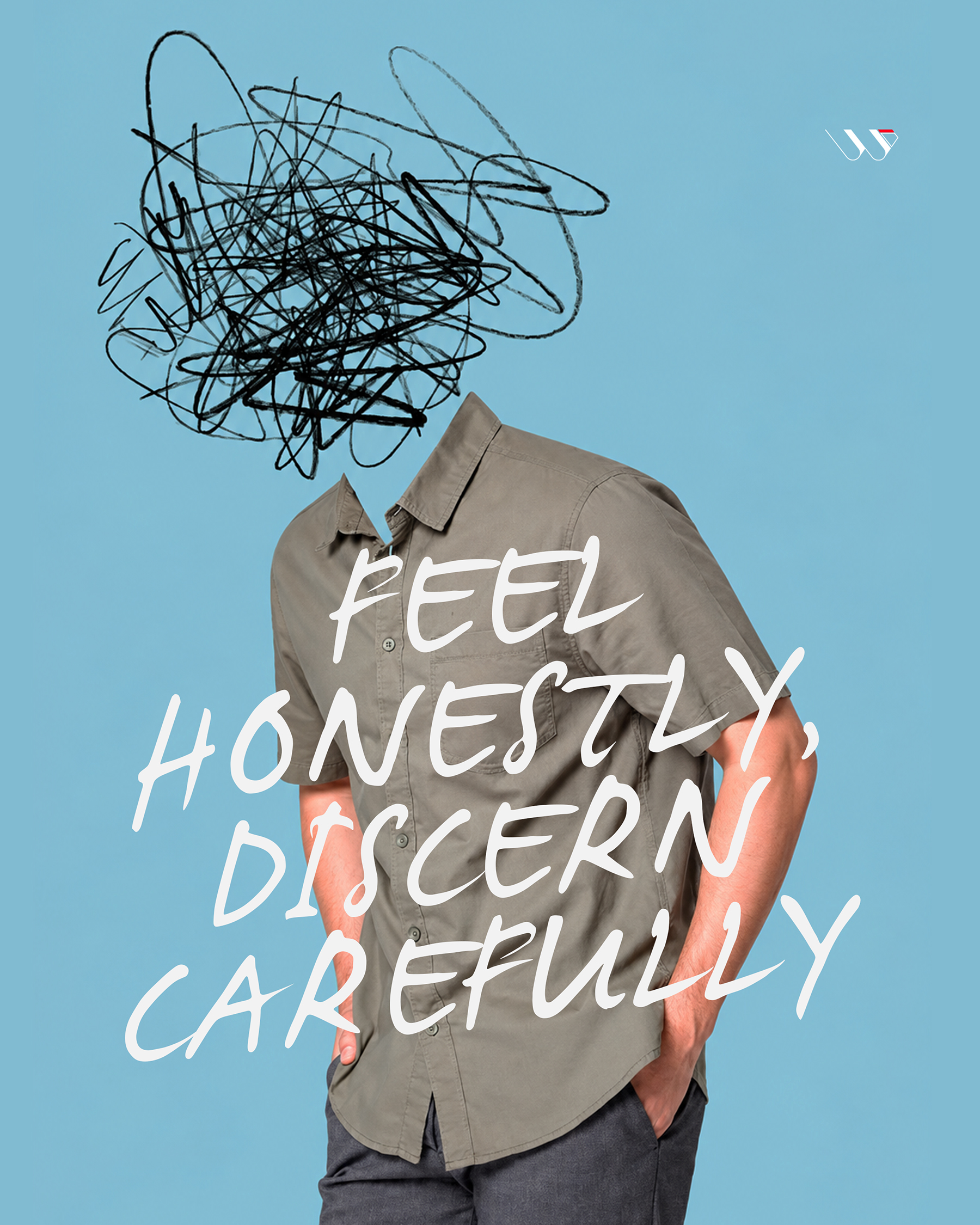
Feel Honestly, Discern Carefully
Emotions don't just tell us how we feel; they reveal what is happening deeper in the heart. You are corrected, and you become unusually defensive. Or a friend’s success may leave you inwardly unsettled, even while you are outwardly celebrating with them. The event may appear small, but the emotional response could be much bigger.
This is why emotional maturity requires more than learning to control outward reactions. It requires discernment.
Proverbs says, “Keep thy heart with all diligence; for out of it are the issues of life” (Proverbs 4:23). What eventually comes out of us often has an inward history. Anger must have been growing from offence. Anxiety has been feeding on assumptions. Jealousy may have been revealing insecurity. A strong emotional response is often the surface expression of a deeper condition of the heart.
The goal, therefore, is not simply to ask, “How do I stop feeling this way?”
Sometimes the more important question is:
“What is this feeling revealing, and what should I do about it?”
Discerning How You Feel
1. Recognise what you actually feel.
This sounds simple, but many people struggle with it, especially when they believe certain emotions make them appear spiritually weak. So instead of admitting, “I am angry,” they call it righteous concern. Instead of saying, “I am afraid,” they hide behind silence. Instead of admitting, “I am jealous,” they begin criticising the person they envy.
I am not referring to accepting how you feel as absolute, as though nothing can be done about it. Rather, I am saying that you cannot properly confront, understand, or govern what you refuse to name.
David was remarkably honest about his emotional state. He wrote, “Why art thou cast down, O my soul? and why art thou disquieted within me?” (Psalm 42:5).
He acknowledged that something was happening within him.
Honesty is not unbelief; it is often where healing and transformation begin
2. Separate the event from your conclusion
This distinction is very important. Someone corrected you: that is the event. “They don't respect me” may be your self-derived conclusion.
Many emotional reactions become stronger because we respond not merely to events, but to the meanings we attach to them.
This is why Scripture places so much importance on the renewal of the mind. Paul says, “Be ye transformed by the renewing of your mind… that you may prove what is that good, and acceptable, and perfect, will of God” (Romans 12:2).
Emotional transformation begins when our interpretations of life change.
3. Trace what may be underneath the emotion.
Anger is not always simply anger. One may be angry because they are hurt. One may be angry because they feel powerless. Sometimes, criticism hurts so deeply because it touches an insecurity you have carried for years.
Jealousy can reveal comparison. Anxiety can reveal fear of losing control. And an unusually strong need for approval can reveal insecurity.
This does not mean every emotion has some hidden psychological explanation. But strong and repeated emotional patterns deserve examination.
David prayed:
“Search me, O God, and know my heart: try me, and know my thoughts” (Psalm 139:23).
That is where discernment becomes important—not merely identifying what we are feeling, but recognising what is feeding it.
4. Test what we are feeling and believing against truth.
Paul writes, “Prove all things; hold fast that which is good” (1 Thessalonians 5:21).
Not every conclusion produced by an emotion deserves agreement. Fear may tell you that everything will go wrong. Offence may tell you that person’s intention was evil. Insecurity may tell you that another person's success diminishes you. Shame may tell you that one failure has become your identity.
But emotions are not immutable; they can shift, deepen, weaken, or change altogether. For that reason, they cannot be upheld as the truth.
This is why the truth of God’s Word must remain a constant beyond the shifting boundaries of emotion, as a standard by which the emotion can be tested, interpreted and brought to proper perspective.
Ask yourself: Is what I am believing actually true? Do I have evidence for this conclusion? Is fear interpreting this situation for me? Is pride involved? Is woundedness speaking? Does this interpretation agree with Scripture and with the character of God?
This is not denying what you feel. It is refusing to allow what you feel to become unquestionable.
5. Choose your response according to truth.
This is where emotional maturity becomes visible. You may still feel angry and decide not to speak or act destructively. You may still feel afraid and obey God. You may still feel hurt and choose not to retaliate.
Jesus showed us this beautifully in Gethsemane. His soul was “exceeding sorrowful, even unto death” (Matthew 26:38), yet He still prayed, “nevertheless not as I will, but as thou wilt” (Matthew 26:39).
The sorrow was real. But the sorrow did not become the final authority.
Sometimes obedience comes before emotional agreement. And often, as truth is continually believed and practised, the emotions gradually begin to follow.
Emotional discernment is not the ability to stop feeling. It is the ability to understand what you feel without immediately surrendering your judgement, words and decisions to it.
A mature believer can acknowledge anger without allowing anger to rule. They can admit fear without making fear their master. They can recognise hurt without allowing hurt to become bitterness.
Scripture says, “Be ye angry, and sin not” (Ephesians 4:26).
The emotion is acknowledged, but a boundary is placed around what it is permitted to produce.
So when strong emotions arise, do not merely suppress them and do not immediately obey them. Bring them into the light. Name what you feel. Separate the event from your interpretation. Examine what may be underneath it. Test your conclusions against God's Word and then choose a response that agrees with truth.
Because emotional maturity is not learning to feel less. It is learning to feel honestly, discern carefully and respond truthfully.




Comments
Please log in to comment.