When God Says, "Now"
Divine seasons rarely arrive carrying a label. There are usually no special announcements on God’s timing: ‘The waiting is over; this is the moment.’ More often, the transition from waiting to moving is discerned in the spirit and by faith in our walk with God. This is precisely why timing requires as much spiritual sensitivity as direction. It is one thing to know what God has said; it is another thing to recognise when corresponding action to what He has said is due.
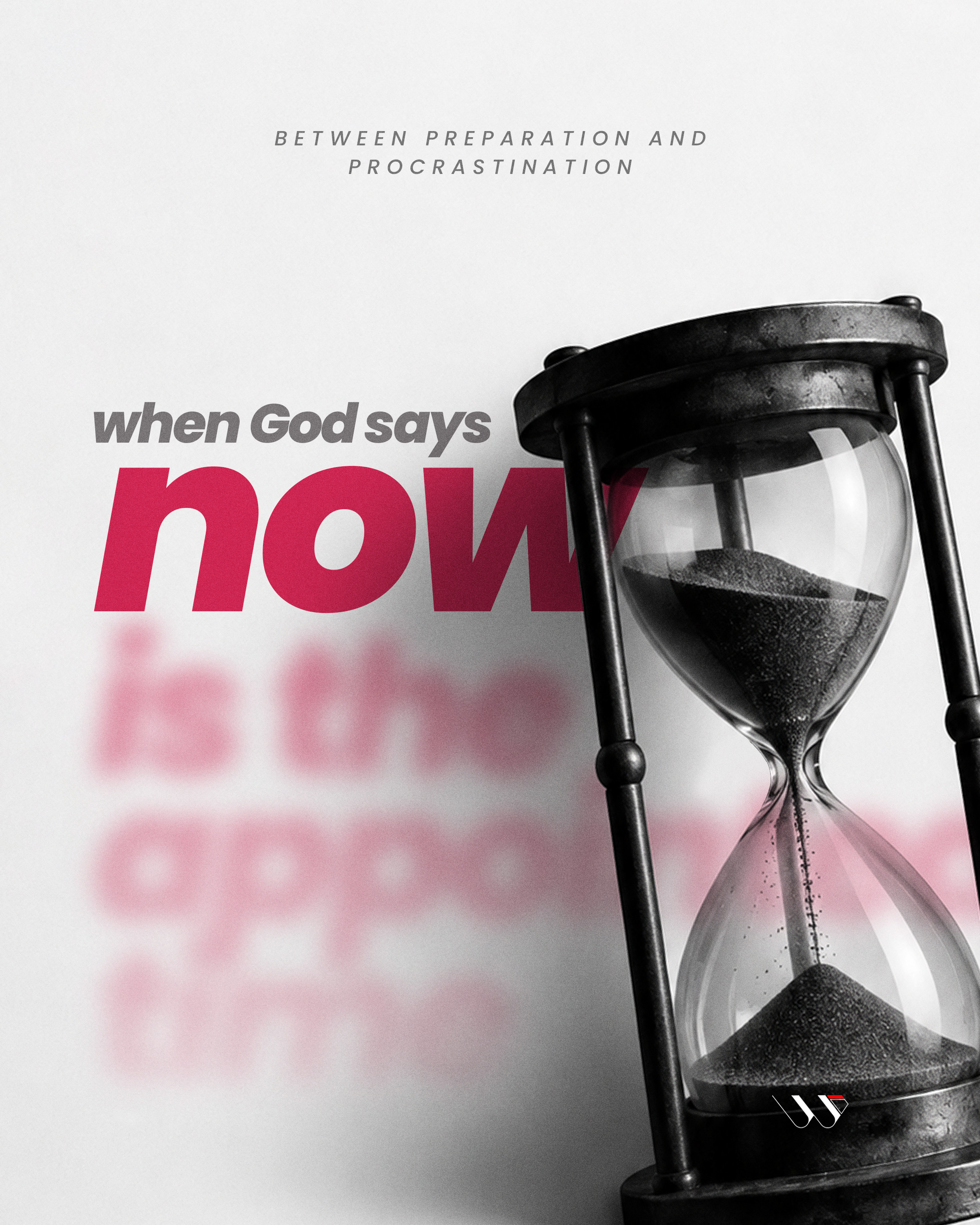
And herein lies another caution to consider: God’s timing falls somewhere between preparation and procrastination. It is like a fruit hanging quietly on the tree. Before its season, it is hard, sour and unready; in its season, it is full, sweet, and fit for its purpose. But leave it hanging beyond its appointed time, and what was once ripe proceeds from ripe to overripe, from overripe to fermentation, and from fermentation to decay.
There is a time when moving would be premature because God is still preparing us, arranging circumstances or developing something necessary in us for the assignment. But there can also come a point when further waiting is no longer patience, but delayed obedience. Wisdom lies in knowing the difference. Preparation says, I will not run ahead of God. Procrastination says, often with more respectable language, I will not move until every uncertainty has disappeared.
So, how can we discern when the time has come
1. The Time Will Never Contradict the Word
The first and safest boundary in discerning timing is Scripture. Divine timing will never require us to violate divine principle. God may not always tell us when in unmistakable terms, but He has already revealed so much concerning how we are permitted to walk. Whatever interpretation we place upon an opportunity, impression, prophecy, dream or circumstance must remain consistent with the character and written Word of God.
This was precisely what preserved David in the cave. David did not need to murder Saul to become king, although everything about the circumstance seemed to favour immediate action. Saul was vulnerable. David had been anointed. His men believed God had arranged the opportunity (1 Samuel 24:4, 6–7,10-12). If circumstances alone determined timing, David had every reason to strike. But there was a higher consideration than opportunity.
Because an opportunity to fulfil divine prophecy presented itself doesn’t mean we should jump right at it. The apparent opening should not suspend our obligation to walk uprightly and continuously before God.
This is important because believers can sometimes become so persuaded about a destination that they begin excusing methods they would otherwise recognise as questionable.
“God showed me this person will be my spouse”; therefore, boundaries can be ignored and the bed defiled (Hebrews 13:4).
“God told me I will be wealthy”; therefore, integrity can be compromised, dishonest gain and fraud are justified (Proverbs 10:2; 1 Timothy 6:9–10).
“God promised me this position”; therefore, I can manipulate, bribe, scheme, or step over others to get there (Proverbs 16:18; Romans 12:10).
No!
If arriving somewhere requires violating what God has already clearly revealed, the route cannot be defended merely because the destination appears prophetic.
Dallas Willard, in his book In Search of Guidance, emphasises that guidance develops within a life that is first acquainted with God and His ways. This is crucial so we don’t interpret Scripture through our impressions; we test our impressions by Scripture.
2. Examine What the Waiting Season Has Been Producing
Secondly, pay attention to preparation. “Knowing this, that the testing of your faith produces patience” —James 1:3. Before certain doors open, there are capacities God desires to develop in us: wisdom, character, discipline, relationships, competence and spiritual maturity.
David was anointed long before he reigned; he had to endure the wilderness, serve faithfully, and learn to wait for the throne without forcing his way onto it.
Moses sensed Israel’s deliverance long before the burning bush; he had to spend forty years in the wilderness building leadership capacity before God sent him back to Egypt with the authority and timing for the assignment.
Joseph received dreams concerning his future long before he governed in Egypt; he had to pass through betrayal, slavery, and imprisonment, where God formed in him the character and wisdom required for the dream.
Following His resurrection, Jesus gave His disciples an unmistakable commission: “Go ye therefore, and teach all nations…” (Matthew 28:19). Yet these same men were instructed not to rush immediately into the nations. Jesus told them to “wait for the promise of the Father” (Acts 1:4). They possessed the assignment but had not yet received the empowerment necessary to fulfil it.
The men and women who had been commanded to wait gave themselves continually to prayer, travailing until the day of Pentecost was fully come. And when the appointed moment arrived, they were endued with power from on high—empowered by the Spirit of wisdom and might to take up the assignment for which they had been waiting.
The waiting was not wasted time; it was the womb in which their capacity for the assignment was formed. After Pentecost, continuing to wait indefinitely would eventually have become disobedience. The instruction had changed from wait to witness.
3. Distinguish Divine Leading from Internal Pressure
Another important indicator is the nature of the voice driving us: the witness of the Spirit or the voice of our emotions. Excitement can create enormous urgency, as well as fear can create paralysis. And because urgency feels powerful, we may easily interpret intensity as spirituality. But strength of feeling is not necessarily evidence of divine timing.
Dallas Willard's book on hearing God is especially helpful here. He emphasised that recognising God's voice grows out of an ongoing relationship with Him rather than an anxious search for extraordinary instructions whenever decisions arise. He also described God's communication as possessing a quality consistent with God's character—rather than the frantic, coercive character of our fears and compulsions.
Just as James expresses concerning heavenly wisdom:
“But the wisdom that is from above is first pure, then peaceable, gentle, and easy to be intreated, full of mercy and good fruits…” (James 3:17). This does not mean divine guidance will always make us emotionally comfortable, but it possesses the character of God.
Jesus was deeply troubled in Gethsemane. He prayed, “Father, if thou be willing, remove this cup from me: nevertheless not my will, but thine, be done” (Luke 22:42). Courage would be unnecessary if obedience always felt comfortable. Therefore, when we speak of peace, we must distinguish spiritual settledness from emotional ease.
You can be nervous and still know what you must do. You can feel the weight of a decision and nevertheless possess an underlying conviction that obedience requires movement. Conversely, you can be extremely excited about something that God has not instructed you to pursue.
This is why, like Jesus at Gethsemane, crossroads should survive prayer and inquiry from God.
“Call to Me, and I will answer you, and show you great and mighty things, which you do not know” (Jeremiah 33:3).
“And thine ears shall hear a word behind thee, saying, This is the way, walk ye in it, when ye turn to the right hand, and when ye turn to the left” (Isaiah 30:21).
The issue is therefore not simply, Am I moving? The deeper question is, What is moving me? Movement, itself, is not progress. You can move and still be outside the will of God. You can wait and still be obeying Him.
4. When obedience is complete
Sometimes, discerning God’s timing is not about waiting for another sign or seeking another instruction; it is about completing the instruction He has already given. “To obey is better than sacrifice” (1 Samuel 15:22). When God has spoken clearly, the appropriate response is not to keep asking, “What next?” but to remain with His last word until our obedience to it is complete.
There is a tendency to become eager for the next phase while the demands of the present one remain unfinished. Yet, in our walk with God, the next instruction does not cancel the responsibility of the last one. We must resist the urge to move ahead simply because we have grown tired of the present step. Sometimes, the reason the next phase has not opened is that there is still obedience required in this one.
Paul captures this principle when he writes, “…and having in a readiness to revenge all disobedience, when your obedience is fulfilled” (2 Corinthians 10:6). Obedience is fulfilled when an instruction is carried through to completion.
God may reveal only one step at a time because that step is where our present responsibility lies. Stay with the instruction until you have exhausted its demands. Stay in the phase until you have completed its assignment. Until we give it all it demands, it cannot release to us all it supplies.
There is “a time to every purpose under the heaven” (Ecclesiastes 3:1). The God who ordains the purpose is also Lord over its timing. He knows when something must be conceived, when it must be prepared, when it must be released. Our responsibility, therefore, is neither to force tomorrow into today nor to remain in yesterday after God has called us forward.
The answer will not always arrive with dramatic signs or unmistakable announcements. Often, it will be discerned quietly through Scripture, prayer, the witness of the Spirit, the fruit of preparation and a heart surrendered enough to obey.
God’s time is not necessarily a moment in time when everything clicks. It is the moment when our obedience and God’s will are fulfilled. And when that moment comes, faith must be willing to move to the next phase.






Comments
Please log in to comment.