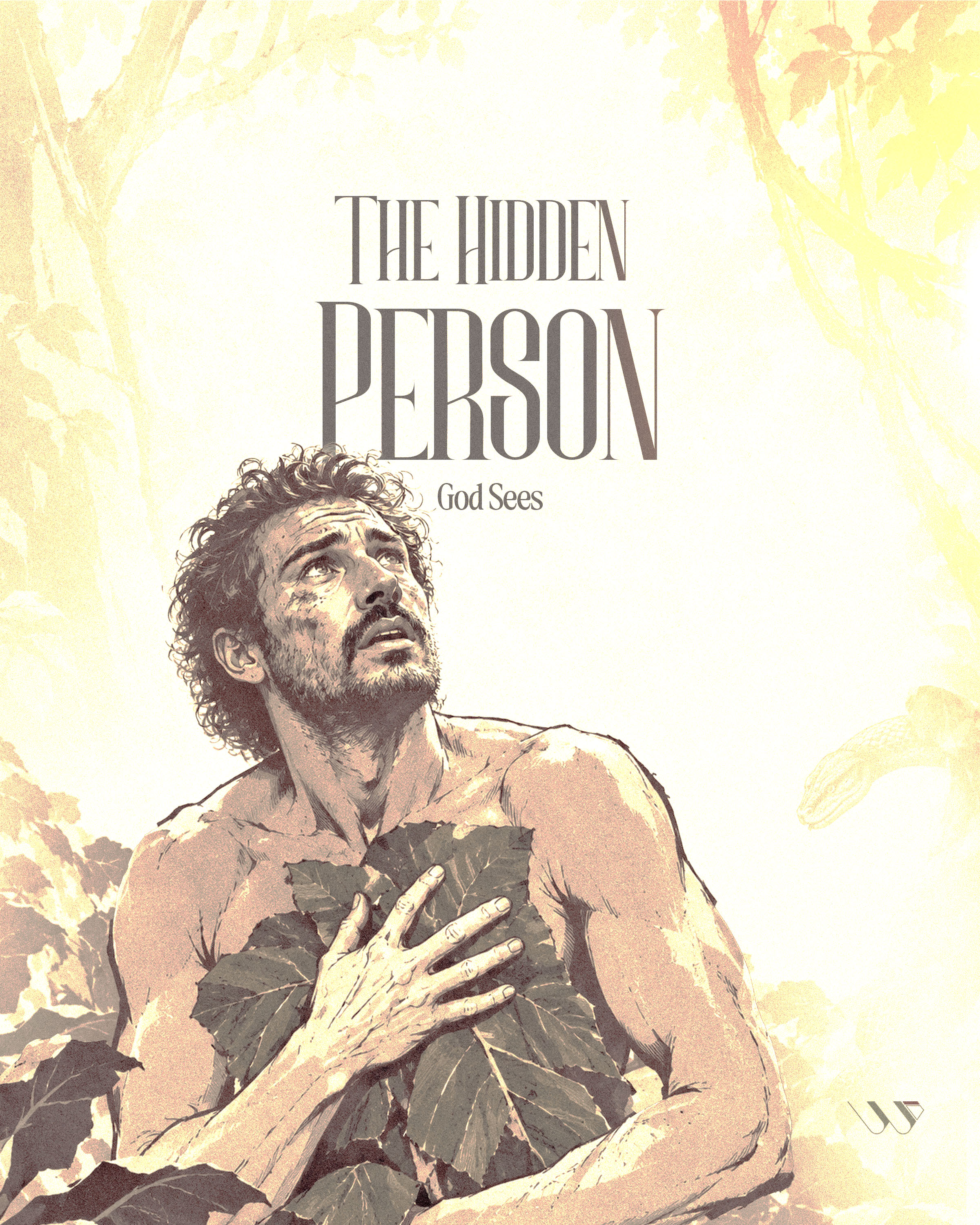
The Hidden Person God Sees
There is a version of you that people know. There is also a version of you that you have convinced yourself of, a version only you know. And then there is the person God sees.
The first is your public life. The second is the private image you have formed of yourself. But the third is the most accurate picture of all; the person you truly are beneath everything people can see.
We live in a world that places enormous value on appearances, impression and perception. We learn how to present ourselves, communicate ourselves, market ourselves and sometimes, even spiritualise ourselves. We know how to say the right things, attend the right places, quote the right Scriptures and behave appropriately in the presence of the right people. But God has always been interested in something deeper than presentation and performance.
When Samuel arrived at Jesse's house to anoint Israel's next king, he was particularly impressed by Eliab's appearance. He attested, “Surely the LORD'S anointed is before him.” But God interrupted his assessment:
“Do not look at his appearance or at his physical stature, because I have refused him. For the LORD does not see as man sees; for man looks at the outward appearance, but the LORD looks at the heart” — 1 Samuel 16:7.
Beyond David's anointing, the story reveals something about God: God sees beneath the visible and is not merely impressed by the visible.
God says, “I, the LORD, search the heart; I test the mind, even to give every man according to his ways, according to the fruit of his doings” (Jeremiah 17:10).
He sees the person beneath the reputation, the motive beneath the action, the desire beneath the decision and the character beneath the achievement. We often measure a person's life by what they have done. God also considers who the person has become while doing it. That distinction matters.
The Outer and Inner Life
Outward action and behaviour can be maintained for many different reasons. A person can appear generous because they genuinely love people. Another may appear equally generous because they want to be admired or because they have selfish interests in mind. This is why Jesus repeatedly addressed not merely what people did, but why they did it.
In Matthew 6, He taught about giving, praying and fasting. These are good spiritual practices. Yet, Jesus warned that even good practices can be corrupted when the desire for God's approval is replaced with the desire for human applause.
That means a person can do all the right things while the inner man is moving in all the wrong directions. My pastor and friend often says, “God vets the purity of motive to the accuracy of action.”
And this is where the inner life becomes important. Your inner life is the place where your desires, motives, thoughts, emotions, convictions and intentions converge. It is the only part of you that people cannot fully access. But God can.
“For the word of God is living and active, sharper than any two-edged sword, piercing to the division of soul and of spirit, of joints and of marrow, and discerning the thoughts and intentions of the heart” (Hebrews 4:12).
The Person Nobody Applauds
One of the clearest tests of character is when no one is watching. It is relatively easy to behave well when there is something to gain from behaving well. But what happens when nobody will know? When there are no rewards, recognition or reputation attached to your decision. This is where character begins to reveal itself.
Joseph gives us a powerful example.
When Potiphar's wife attempted to seduce him, Joseph was not standing before any audience. There were no cameras. He never even knew the account would eventually be documented for our learning.
It was simply a personal decision. Joseph's response is remarkable: “How then can I do this great wickedness, and sin against God?” (Genesis 39:9). He did not merely think about what would happen to his reputation if he were discovered. He thought about God’s displeasure.
Integrity is what happens when your private convictions remain stronger than public incentives.
God Is Interested in the Person Behind the Action
Sometimes we become so focused on doing things ‘for God’ (in quotes) that we forget that God is also doing something in us. God is not merely concerned with what is being built by us; He is more interested in what is being formed in us.
A person can build a successful career, business or ministry while becoming increasingly proud. A person can become financially successful while becoming more and more selfish and stingy. This is why spiritual growth cannot be measured only by activity. Doing more does not automatically mean we are becoming more like Christ.
Paul's prayer for the Galatians was not simply that they would become more productive Christians. He said: “My little children, of whom I travail in birth again until Christ be formed in you” (Galatians 4:19).
Christ must be formed in us. Not merely Christ preached by us or talked about by us.
The Danger of a Divided Life
There is nothing more exhausting than maintaining two versions of yourself: the person people think you are and the person you know yourself to be. The greater the distance between them, the greater the internal tension.
Jesus repeatedly confronted this kind of divided spirituality. He described people who looked righteous outwardly while being evil inwardly. “For ye are like unto whited sepulchres, which indeed appear beautiful outward, but are within full of dead men's bones ” (Matthew 23:27).
Jesus was not moved nor impressed by polished appearances that concealed inward corruption. And this is why Christianity cannot merely be behavioural modification, but life transformation. The Holy Spirit was not given merely to improve our public behaviour while leaving the inner person untouched. He works from the inside out. This is why Scripture speaks about the renewing of the mind (Romans 12:2), the cleansing of the heart (Psalm 51:10) and the fruit of the Spirit (Galatians 5:22–23).
The Hidden Person Is Still Being Formed
We often think the inner man is instantly transformed at New Birth. What we receive is a ‘new spirit’ (Ezekiel 36:26), not a new mind. But we must renew our minds by subjecting them to the ‘law of Life’, which is in Christ.
Peter uses an interesting expression when speaking about Christian character:
“But let it be the hidden man of the heart...” — 1 Peter 3:4.
There is a hidden person, and that person is being formed every day. Every decision contributes something. Every repeated thought contributes something; every tolerated attitude contributes something. Every secret habit contributes something. Likewise, every act of obedience contributes something. Every time we forgive, resist temptation, tell the truth, surrender pride, practise patience or choose love when we would rather retaliate, something is happening within us. Character is rarely formed in dramatic moments. It is usually formed through repeated small decisions that nobody celebrates. This means the ordinary parts of your life are spiritually significant.
Becoming the Same Person Everywhere
The question of the inner life is therefore not meant to produce unhealthy self-fixation. But it is an invitation to honest examination.
David prayed: “Search me, O God, and know my heart: try me, and know my thoughts.” — Psalm 139:23, KJV
God’s response is not shame; it produces light. When God reveals something within us, His purpose is not merely to embarrass us with what is wrong. He reveals so that He can transform. The Spirit searches, the Word exposes, grace corrects and Christ forms.
Perhaps one of the clearest signs of spiritual maturity is increasing consistency between the person you are publicly and the person you are privately. Not perfection but integrity.
The goal of the Christian life is not to become impressive. It is to become whole.
To love God when nobody is watching. To obey when nobody will applaud. To remain humble when recognition comes. To remain faithful when recognition does not come. The world may only see the tree. God sees the root.
A day would come when much of what currently occupies our attention will lose its significance. In those moments, we’d ask ourselves the most important questions:
What have I become? And at what cost? Have I lived a good life? Or a fulfilled life?




Comments
Please log in to comment.