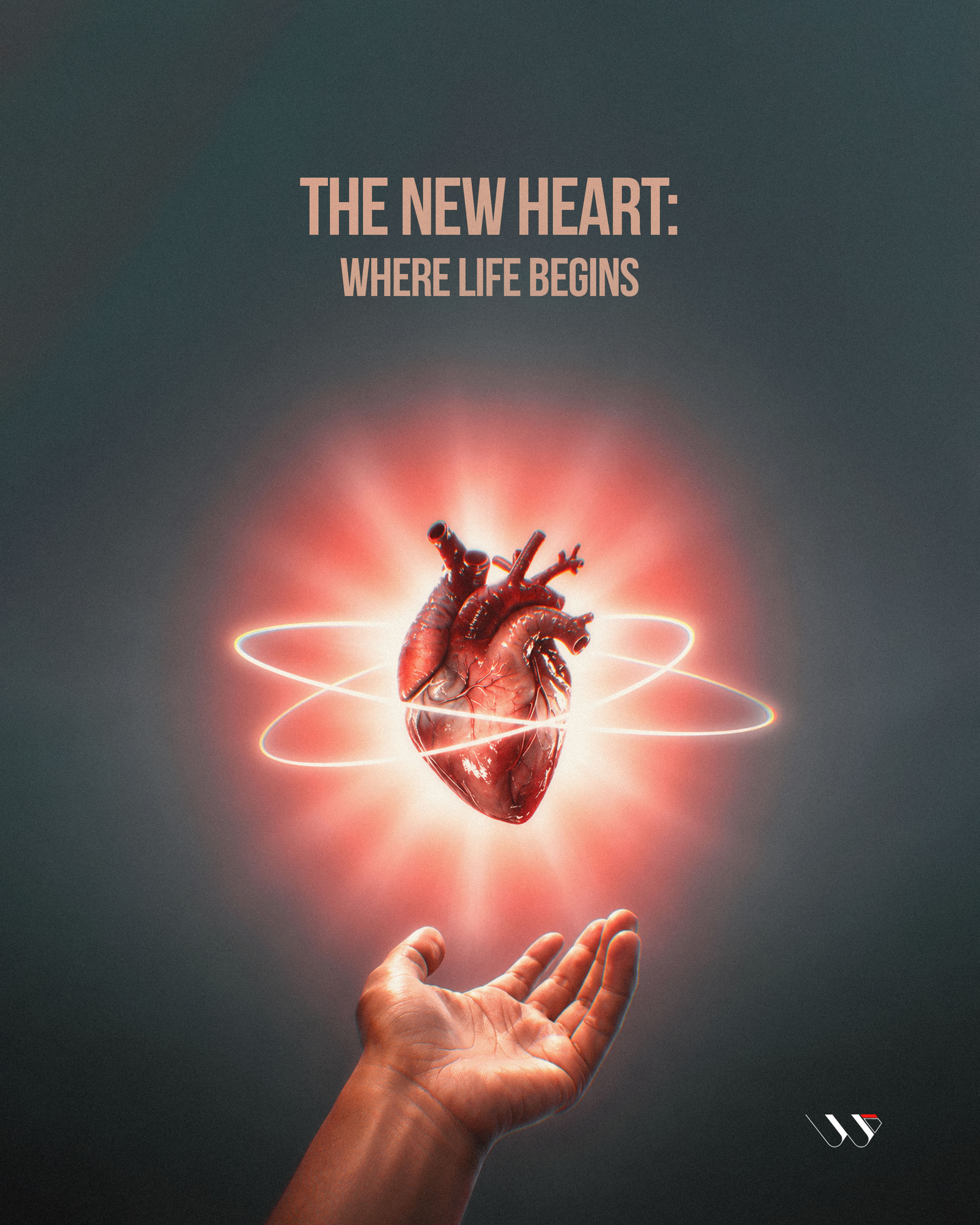
The New Heart: Where Life Begins
When someone says, “I love you with all my heart,” they usually mean their affection or emotions. When people say, “Follow your heart,” they often mean, “Follow what you feel.” But when the Bible speaks about the heart, it speaks about something far deeper than the organ beating between your ribs. It is referring to the inner man—a part of you no X-ray can capture, yet from which much of your visible life proceeds.
This is why Scripture says: “Keep thy heart with all diligence; for out of it are the issues of life” (Proverbs 4:23). In other words, much of what eventually becomes visible in a person's life has an invisible origin—the heart.
The Hebrew words commonly translated as heart are lev and levav, while the Greek word is kardia. In Scripture, these terms broadly refer to a person's inner centre—the seat of thought, desire, emotion, imagination, intention, moral disposition, and even the human spirit.
The heart can think, understand, and desire. It can intend, love, and choose. It can believe, doubt, refuse, submit, and rebel. Therefore, when Scripture speaks of the heart, it is not referring merely to the emotional or intellectual aspect of a person. Rather, it speaks of the whole inner environment.
Consider this:
“For as he thinks in his heart, so is he…” (Proverbs 23:7).
Did you notice that? We think in our hearts.
Again, Jesus said:
“…for out of the abundance of the heart the mouth speaks” (Matthew 12:34).
Sometimes, we surprise ourselves with our own actions and say, “I don't even know why I did that.” Life has a way of squeezing us, and whatever has been stored inside eventually finds expression. Yet Scripture repeatedly directs our attention back to our inner command centre.
Is the Heart the Same as the Mind?
Not exactly. We can already catch a glimpse of the difference above.
Although Scripture sometimes uses these expressions in ways that overlap, there are still significant distinctions:
The mind particularly concerns thinking, reasoning and understanding.
The emotion concerns affective responses—joy, sorrow, fear, anger, warmth and so on.
The will concerns our capacity to choose and act.
The human spirit speaks of that deepest dimension of man which, especially under the New Covenant, relates with God.
In Scripture, however, the heart functions as a broad description of the inner person and frequently overlaps with thought, desire, emotion, intention, will and spirit.
This is important in interpreting Scripture because if you reduce the heart merely to feelings, you will misunderstand much of what Scripture teaches about the inner life.
For example, Proverbs 23:26 says, “My son, give me your heart, and let your eyes observe my ways.” So, when God asks for your heart, He is not merely asking for an emotional or logical response. He is asking for all of you.
The Condition of The Heart
Just as the physical heart can be weak, diseased, or healthy, Scripture also speaks of different conditions of the inner heart. These conditions have nothing to do with sensual or emotional intelligence.
Scripture speaks of the heart in many different conditions: a hardened heart (Exodus 8:15), a merry heart (Proverbs 17:22), a proud heart (Proverbs 16:5), a divided heart (Hosea 10:2), a wise heart (Proverbs 10:8), a deceitful heart (Jeremiah 17:9), a tender heart (Ephesians 4:32), a broken and contrite heart (Psalm 51:17), and even a foolish heart (Romans 1:21), among others.
This reveals that the condition of the heart matters deeply to God. The heart can deteriorate, become hardened or divided, but it can also be transformed. And so, beyond merely identifying the condition of the heart, Scripture points us towards the reality of a renewed heart. David prayed:
“Create in me a clean heart, O God; and renew a right spirit within me” (Psalm 51:10).
This explains why two people can hear the same truth and respond to it completely differently.
Jesus illustrated this in the parable of the sower in Matthew 13. “Behold, a sower went forth to sow…” (Matthew 13:3). The sower remained the same, the seed remained the same, but the ground differed.
“Now the parable is this: The seed is the word of God… those by the wayside are the ones who hear; then the devil comes and takes away the word out of their hearts…” (Luke 8:11-12).
Therefore, the question is not always, “Has God spoken?” Sometimes, the more important question is, “What is the condition of my heart?”
The Hardened Heart
One of the sobering things Scripture teaches us is that a heart can become hardened. And hardness does not always arrive dramatically; it develops gradually.
A person hears truth and repeatedly refuses to respond. They are corrected, but continually justify themselves. Conviction comes, but they keep negotiating with it. They know something is wrong, but repeatedly choose it. Unknowingly, the heart is being trained to be irresponsive to the Truth. Eventually, what once troubled them stops troubling them in quite the same way.
This is why Scripture warns: “Harden not your hearts…” (Hebrews 3:8).
The Divided Heart
David prayed something remarkable: “…unite my heart to fear thy name” (Psalm 86:11).
This reveals that a heart can be divided. It is possible to want God and still want something else more. It is possible to desire righteousness while secretly preserving compromise. It is possible to pray, “Lord, let Your will be done,” while inwardly hoping that His Will will conveniently agree with yours. This is the problem of a divided heart.
Therefore, spiritual growth is not always about God adding more things to your life. Sometimes, God is removing competing loves. He is teaching you not only to know what He wants, but to increasingly want what He wants.
The Renewed Heart
If the study of the heart ended with Jeremiah 17:9, we would have a very depressing subject on our hands. Thank God it does not end there. The Bible does not merely diagnose the condition of man's heart; it reveals God's remedy to it.
Through Ezekiel, God promised: “A new heart also will I give you, and a new spirit will I put within you…” (Ezekiel 36:26). This is one of the great promises of the New Covenant. God's answer is not simply to manage your bad heart condition, no! He speaks of a new heart—a spiritual heart transplant. This is at the centre of the Christian experience.
One may ask, “Do I not seem to contradict myself? If what we receive is a new spirit—a new heart, and not automatically a new mind, how then can the heart be described as encompassing the mind?”
Scripture says that “ye are God’s building” (1 Corinthians 3:9). Think of the new heart as a new site or bare ground prepared, capable of receiving and accommodating the mind of Christ and the Life that is in Him. The ground is new, but what is built upon it must still be progressively formed.
Borrowing the analogy from Jesus’ teaching:
“No man putteth new wine into old bottles; else the new wine will burst the bottles, and be spilled, and the bottles shall perish. But new wine must be put into new bottles; and both are preserved” (Luke 5:37–38).
The Word renews our thinking. Truth exposes deception. Grace changes the way we respond to failure. Obedience retrains our desires. Repentance softens what has grown hard. Love gradually displaces selfishness. The Spirit works within the believer, and as we yield to Him, the inner man begins to be transformed. Christ is formed in us. Christianity is no longer cosmetic, but intrinsic.
God is not merely interested in making your life look better. He wants to transform the source from which that life proceeds.
Continued…




Comments
Please log in to comment.