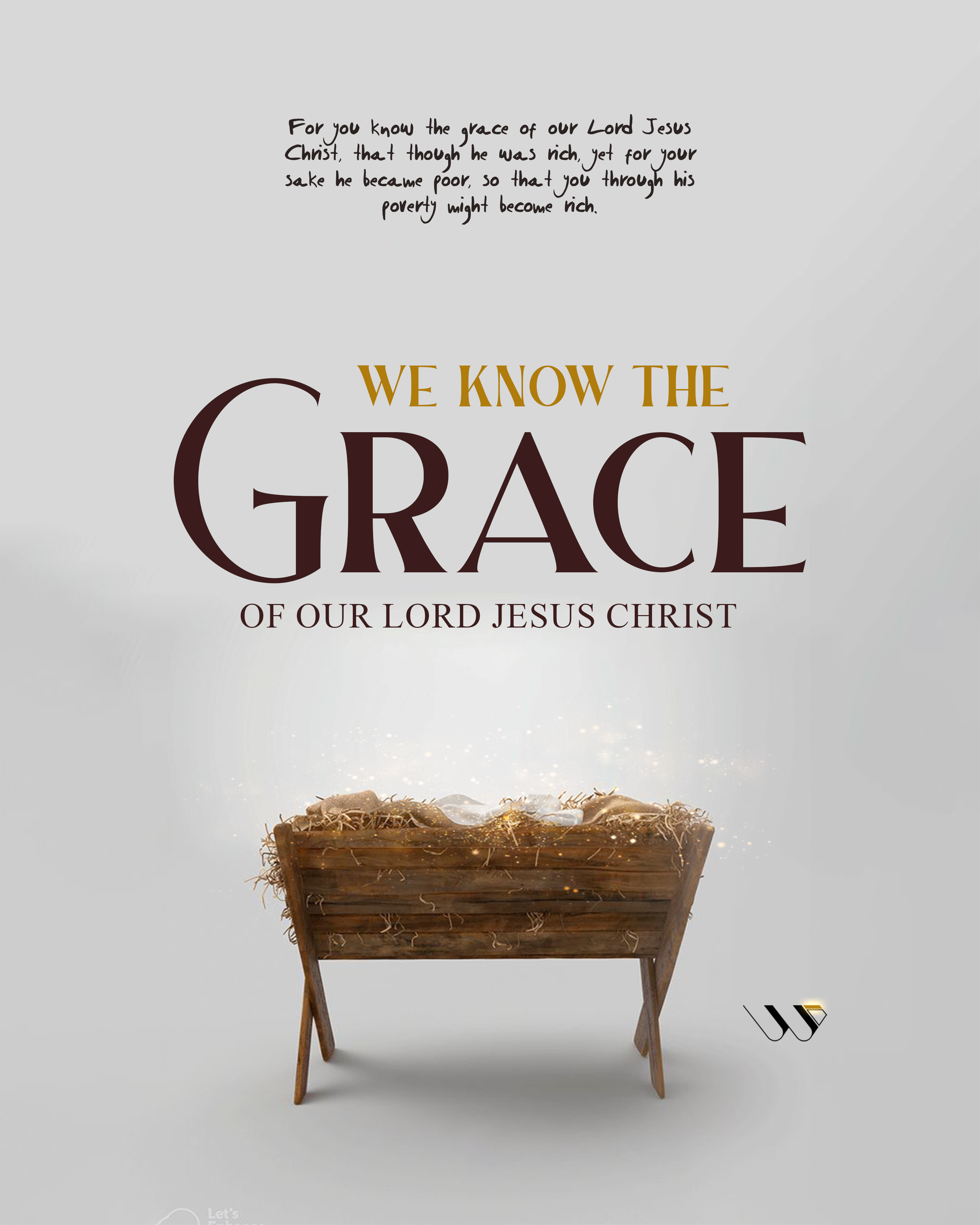
We Know the Grace of our LORD, Jesus Christ
There are moments when waiting feels longer than expected—when anticipation gives way to apprehension, prayers seem unanswered, and promises appear delayed. Yet, anchored in the integrity of His Word, we are reminded that God is never early, never late—He is always faithful. For generations, Israel waited for the Messiah, and through what seemed like silent nights, morning finally broke. Christmas morning teaches us this humble truth: God keeps His promises.
Thank God it’s Christmas—another opportunity to remember His promises. My pastor remarked humorously during the Christmas Eve service yesterday, “The fruits of a tree are always in abundance in its season. Likewise, the manifold riches of His grace are in abundance this Christmas season.” I believe the principal attribute of Jesus is grace (John 1:14). Even when the Apostle Paul identified the Godhead by attribute, he began with “the grace of the Lord Jesus Christ.” This grace is openly accessible to all who are willing to receive it.
The measure of a believer’s well-being is a reflection of the measure of grace they experience. “Who makes you differ from another? And what do you have that you did not receive?” (1 Corinthians 4:7). Paul testifies, “By the grace of God I am what I am… I laboured more abundantly than they all—yet not I, but the grace of God which was with me” (1 Corinthians 15:10). Even spiritual growth is a product of grace. Thus, Paul prayed for the church: “I commend you to God and to the word of His grace, which is able to build you up and give you an inheritance among all those who are sanctified” (Acts 20:32).
Grace is not favour, though it manifests as favour. Grace is not power, yet it expresses itself as power. Grace is the life and Spirit of God made available to and in man through Christ—to will, to do, to become, to receive, and to accomplish God’s purposes. It is popular theology that grace is unmerited, a truth that can be misunderstood and sometimes abused as a license for passivity. While grace cannot be merited, we have to labour to maximise it. Paul said, “and his grace which was bestowed upon me was not in vain; but [rather] I laboured more abundantly than they all” (1 Cor. 15:10). The unmerited dimension of grace speaks to our inability to earn it, as God does not owe us anything. Jesus illustrates this clearly in the Parable of the Master and the Servant (Luke 17:7–10), concluding, “When you have done everything commanded of you, say, ‘We are unworthy servants; we have only done our duty.’”
In simple terms, grace may be described as God’s good gifts. As the Psalmist declares, “For the LORD God is a sun and shield; the LORD will give grace and glory; no good thing will He withhold from those who walk uprightly” (Psalm 84:11). Yet, for every kingdom benefit, there is a corresponding responsibility. In this case, walking and growing in faith is the price we pay to continually enjoy the flow of grace. “By whom also we have access by faith into this grace wherein we stand” (Romans 5:2). “The just shall live by faith” (Romans 1:17), and “faith comes by hearing, and hearing by the Word of God” (Romans 10:17). Therefore, our desire to learn of Him (Matt. 11:29), walk with Him, and grow in the knowledge of Him is the covenant pathway to the continuous flow of grace. “But He gives more grace… God resists the proud, but gives grace to the humble” (James 4:6).





Comments
Please log in to comment.