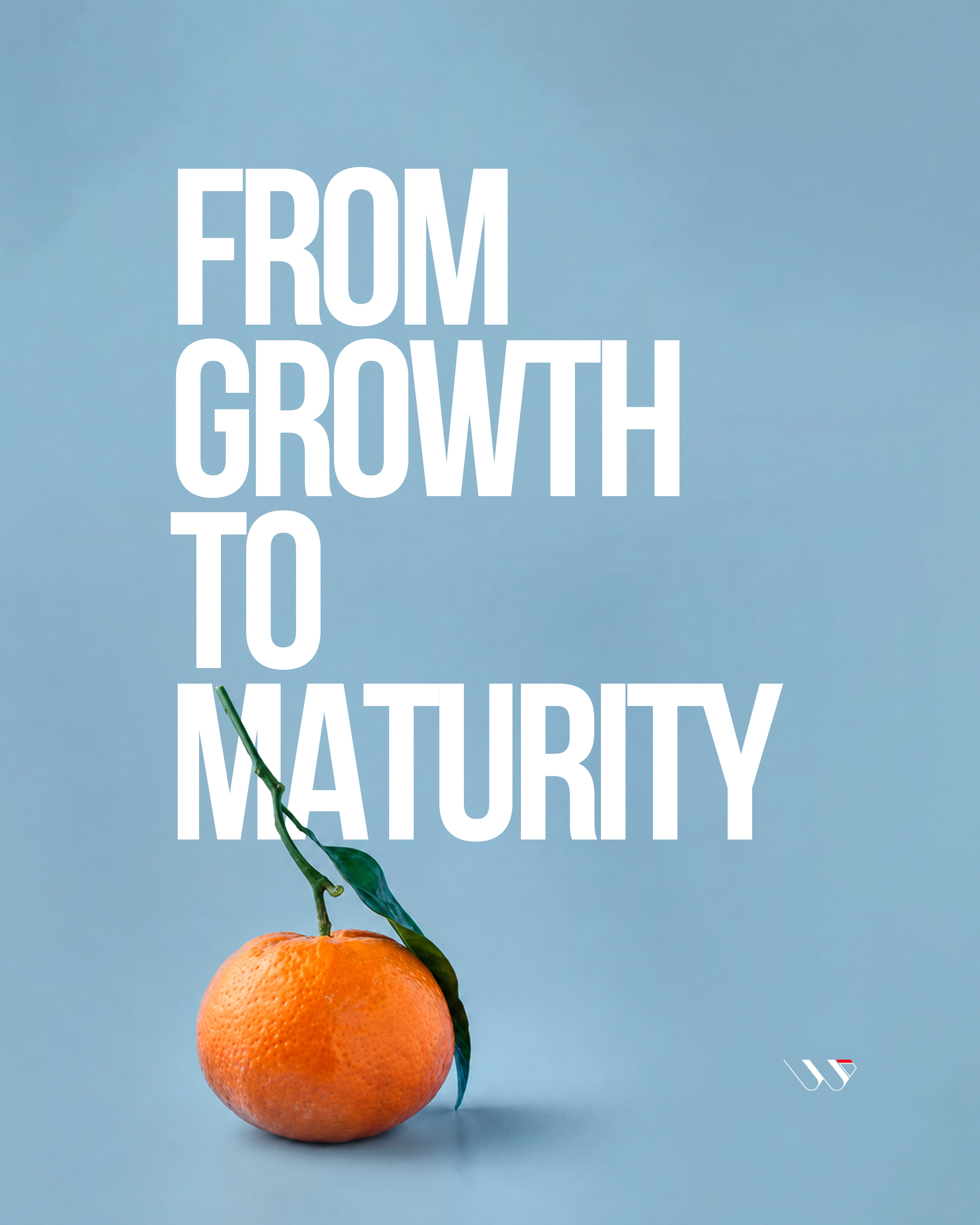
From Growth to Maturity
Spiritual maturity is often measured by what is visible. We look at how much a person knows about Scripture, how eloquently they pray, how effectively they minister, or how deeply they appear to understand spiritual matters. While these things may reflect aspects of growth, they do not necessarily reveal the heart’s true condition.
A person can be deeply knowledgeable and still be emotionally unstable. One can be gifted in ministry yet struggle with pride, resentment or self-control. It is possible to speak convincingly about faith while remaining inwardly governed by fear, insecurity or personal ambition. This reveals an important truth: spiritual maturity is not merely the accumulation of spiritual knowledge or the development of spiritual abilities; it is the transformation of the person within.
Throughout this series, we have examined the heart, thoughts, desires, motives, emotions, conscience and human spirit. These are not disconnected subjects. Together, they help us understand somewhat of the complexity of the inward man and why genuine transformation requires more than changing outward behaviour. Proverbs says, “Keep thy heart with all diligence; for out of it are the issues of life” (Proverbs 4:23).
Spiritual Growth and Spiritual Maturity
Growth and maturity are closely related, but they are not identical. Growth speaks of development; maturity speaks of the quality of that development. A believer may be increasing in knowledge, experience and spiritual activity without showing corresponding maturity in character.
The writer of Hebrews addressed believers who, after considerable time, should have been able to teach others but still needed to be taught the elementary principles of God's Word (Hebrews 5:12). Time had passed, but time alone had not produced maturity. The same can be true of us. A person may attend church for many years without becoming more patient, study Scripture extensively without becoming more humble, or serve faithfully while remaining deeply self-centred.
Spiritual maturity is therefore revealed not merely by what we have acquired, but by what has been formed within us. Paul expressed this goal when he wrote, “My little children, of whom I travail in birth again until Christ be formed in you” (Galatians 4:19). The aim of spiritual development is not simply to know more about Christ, but for His character to be increasingly formed in us.
The Inner Life Is the Foundation
In the natural world, the strength of a tree depends greatly on what happens beneath the surface. Its roots determine how firmly it stands, how effectively it receives nourishment and how well it survives difficult conditions. In much the same way, the stability of our spiritual lives is closely connected to the condition of our heart.
Jesus said, “A good man out of the good treasure of his heart bringeth forth that which is good” (Luke 6:45). Our outward responses often reveal what has been accumulating within. Pressure does not always create what we see; sometimes it simply exposes what was already there.
When criticism produces hostility, it may reveal pride or insecurity. When another person's success provokes resentment, it may expose comparison or unhealthy desire. When disappointment produces bitterness, it may reveal expectations that have quietly taken root. The issue is not only the outward reaction, but the inward condition from which that reaction emerged.
This is why Proverbs 4:23 instructs us to guard our hearts with all diligence; for out of it are the issues of life.” God is not merely interested in modifying outward behaviour; He is concerned with the inner source from which that behaviour proceeds. He works from the foundation upward because if the foundation be destroyed, what can the righteous do? (Psalm 11:3). Lasting transformation must begin at the source.
Maturity and the Government of the Inner Life
One of the clearest signs of maturity is the growing ability to respond wisely rather than react impulsively. An immature inner life is easily governed by immediate feelings, desires and circumstances. Offence quickly becomes retaliation, disappointment becomes withdrawal, fear becomes disobedience, and praise can easily become pride.
Maturity does not mean that difficult emotions, desires or inner conflicts disappear. It means they no longer possess unquestioned authority.
Scripture says, “Be ye angry, and sin not” (Ephesians 4:26). Anger may arise, but anger does not have to determine the response. Fear may be present, yet obedience can still follow. Desire may be strong, yet self-control can refuse to let desire become master. This is why Paul includes “temperance” or self-control among the fruit of the Spirit (Galatians 5:22–23).
The mature believer learns to recognise what is happening within and bring it under the government of truth and the influence of the Holy Spirit. Spiritual maturity is not the absence of inner conflict; it is the increasing ability to respond to that conflict in a way that reflects Christ.
The Renewed Mind and the Mature Believer
The mind plays an important role in this formation because our thoughts influence how we interpret life. They shape our expectations, affect our emotions and often determine our responses. This is why Paul says, “Be ye transformed by the renewing of your mind” (Romans 12:2).
Transformation requires a change in the way we think.
The world continually presents patterns of thought shaped by comparison, self-interest, material ambition and the pursuit of recognition. If these patterns remain unchallenged, they can quietly enter our understanding of the Christian life. We may begin to measure worth by productivity, spiritual significance by public visibility, or God's favour by material success.
A renewed mind learns to interpret life through the truth of Scripture rather than merely through the assumptions of the surrounding culture. This does not mean mature believers never encounter wrong thoughts. It means they have learnt not to accept every thought without examination.
Paul writes of “bringing into captivity every thought to the obedience of Christ” (2 Corinthians 10:5). The mature believer understands that not every thought deserves agreement, just as not every emotion deserves obedience and not every desire deserves fulfilment.
This is where the different aspects of the inner life begin to come together. The mind is renewed by truth, desires are examined, motives are purified, emotions are brought into proper order, the conscience is informed by Scripture, and the human spirit becomes increasingly responsive to the Holy Spirit. None of these areas develops in complete isolation from the others.
The result is an inward life that is gradually coming into alignment with God.
Spiritual maturity, therefore, is not simply becoming more knowledgeable, more gifted or more experienced. It is becoming increasingly like Christ from the inside out. Paul says that we are “changed into the same image from glory to glory, even as by the Spirit of the Lord” (2 Corinthians 3:18).
That transformation begins where people may not immediately see it, but it does not remain hidden forever. What God forms within eventually begins to appear in our thoughts, responses, relationships, choices and character.
The deepest evidence of spiritual maturity is not merely how much of God we can speak about, but how much of the life of Christ is being formed within us and expressed through the way we live.





Comments
Please log in to comment.