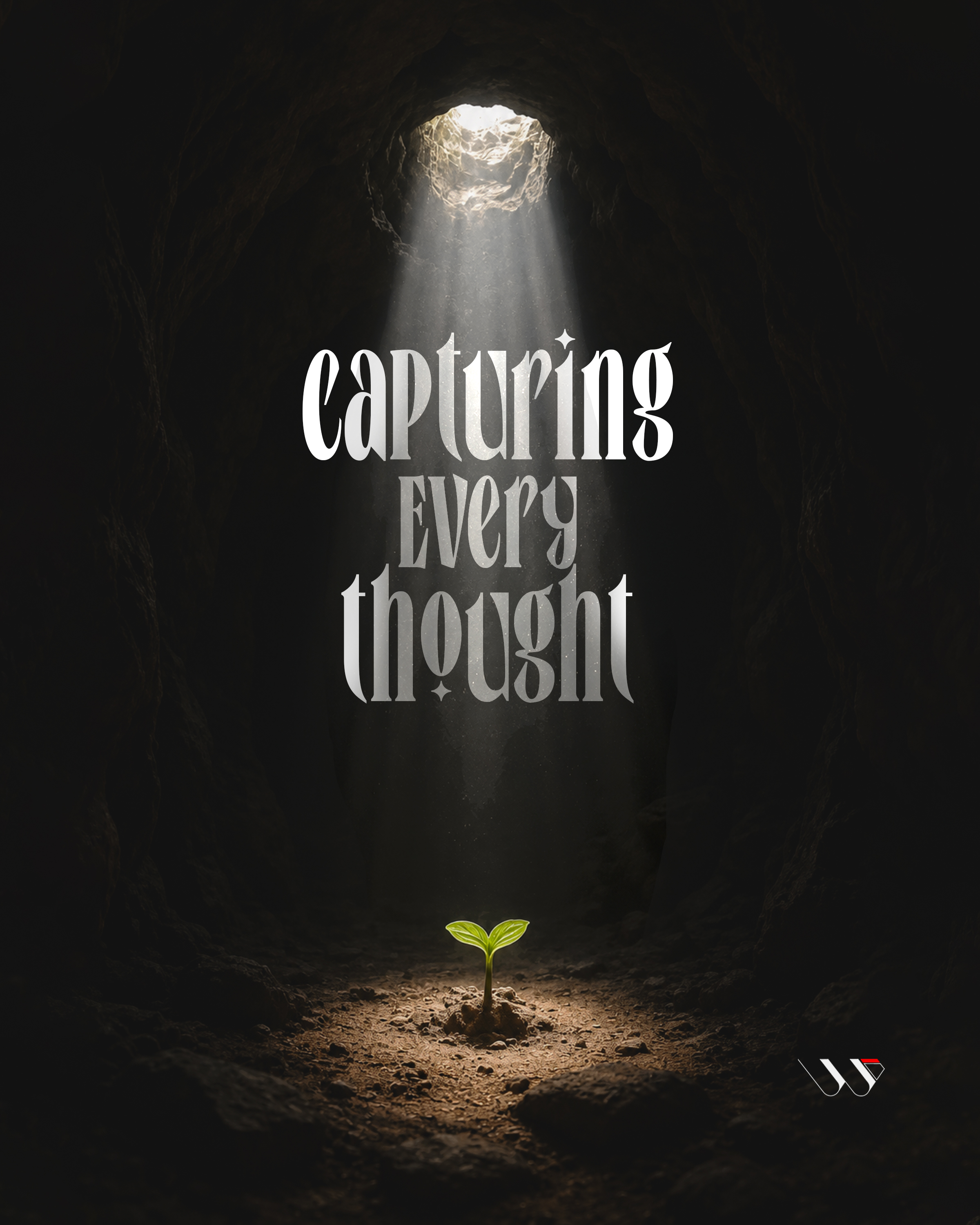
Capturing Every Thought
Think about a flowerpot left untended for several weeks. Nobody needs to plant weeds in it; given the right conditions, they appear on their own and begin to grow. But if you want to grow tomatoes, flowers or anything useful there, you must intentionally plant the right seed, nurture it and keep removing whatever threatens it (be it weeds or pests). The mind works similarly; wrong thoughts don't always need an invitation to appear, but right thinking often must be cultivated deliberately. If the mind is left untended, whatever enters eventually begins to grow.
What exactly is a thought?
A thought is an idea, image, impression, judgement or consideration that passes through the mind. Thoughts may arise from what we perceive through our senses—including not only sight, hearing, smell, taste, and touch, but also internal bodily awareness such as proprioception. They are often shaped when mixed with the existing store of what we have seen, heard, remembered, learnt, or experienced.
Not every thought, however, is deliberately produced. Some arise unexpectedly and without conscious effort. You may suddenly remember something embarrassing from years ago, imagine something going wrong tomorrow or feel suspicious about someone's actions without consciously deciding beforehand to think about it.
This distinction is important because having a thought is not necessarily the same as choosing a thought.
Consider what Hebrews says about Jesus: “[He] was in all points tempted like as we are, yet without sin” (Hebrews 4:15).
Think about that for a moment. Jesus had already raised the standard in Matthew 5:28 when He said, “Whosoever looketh on a woman to lust after her hath committed adultery with her already in his heart.” Sin, therefore, cannot be reduced merely to outward acts; it can also involve what is deliberately entertained, desired, and embraced within the heart.
So when Scripture describes Jesus as “without sin,” it speaks not merely of a life free from sinful actions, but of complete inward purity as well. He was in all tempted, yet He never yielded; neither in conduct nor in the desires and intentions of the heart.
Probably not the best illustration: imagine Jesus walking along the road with His disciples on the way to Samaria. Ahead of them is an attractive young woman, perhaps dressed or walking in a way that naturally draws attention. The disciples notice her and begin whispering among themselves, “Peter, look at her.” Jesus sees the woman ahead and hears the whispers behind him. The scene is in His awareness; it forms a thought in His mind—temptation has presented itself.
This is where I am going with this, and the distinction is very important: temptation can present itself to the mind without the person’s consent. Awareness is not agreement. A thought may appear before the mind without being welcomed into the heart.
Therefore, the appearance of a lustful suggestion does not automatically mean that lust has been embraced. Temptation may knock at the door of the mind; sin begins when the heart opens the door, entertains it, desires it, and gives it consent. Proverbs says, “My son, if sinners entice thee, consent thou not” (Proverbs 1:10).
Jesus was genuinely tempted in all things, yet remained completely without sin, and so can we.
The important question is what happens after the thought appears. Do you dismiss it, or do you entertain it? Do you challenge it, or begin building upon it? Do you repeatedly rehearse it until it becomes a desire?
This is where thoughts begin to differ from intentions and desires. A thought can appear without your permission, but an intention involves the will moving towards a thought. Desire goes further: the thought has begun to attract affection. James describes this progression when he writes, “Every man is tempted, when he is drawn away of his own lust, and enticed. Then when lust hath conceived, it bringeth forth sin…” (James 1:14–15).
A passing thought can therefore become dangerous when it is continually welcomed and entertained. What appeared first in the mind can eventually gain the agreement of the heart.
The distinction between the heart and the mind is important because if you think about an offence repeatedly, bitterness begins to develop. You continually imagine failure, and fear begins to settle in. Repeatedly dwell on what another person has, comparison can slowly mature into envy.
The thought may have arrived without your permission, but what happens next matters greatly. What you repeatedly entertain, you gradually give room to grow. Thoughts do not remain intellectually harmless. Eventually, thought can influence affection, desire, decision and behaviour.
The Undisciplined Mind
An undisciplined mind is not necessarily an unintelligent mind. I have seen highly intelligent people who still exercise very little control over what they repeatedly allow themselves to think about and, consequently, what those thoughts eventually permit them to do.
An undisciplined mind gives almost every thought permission to stay.
Someone says something negative to you, and you replay it for a week. You imagine what they meant, why they meant it, how it is unfair to you; you even create scenarios and imaginings for what was not meant, until emotions begin to arise as though it really happened. Repeated speculation and imagined scenarios can become fertile ground for anxiety.
This is why Scripture does not teach us to believe all things but to try all things (1 Thessalonians 5:21). Whatever is not consistent with the truth from God’s Word, or the character of His Christ, is a lie.
Paul says we should be “bringing into captivity every thought to the obedience of Christ” (2 Corinthians 10:5). That is active language. Some thoughts must be stopped. Some assumptions must be questioned. Some imaginations must be pulled down. Some internal stories must not be cut short.
Capturing Every Thought
So what does it practically mean to take a thought captive?
First, notice the thought. Many thoughts become powerful simply because we never pause long enough to identify them. You may only feel anxious, offended or discouraged, but beneath that emotion there is often a thought being rehearsed.
Then name it honestly. “I think I am going to fail.” “I think they are deliberately ignoring me.” “I think I must prove myself.” “I think their success means I am behind.” Bringing the thought into clear language makes it easier to examine.
Next, test it. Ask: Is this actually true? What evidence do I have? Is this assumption, fear, pride, offence or truth? Most importantly, does this agree with the character and Word of God?
Scripture says, “Prove all things; hold fast that which is good” (1 Thessalonians 5:21). The principle applies here: not everything that enters the mind deserves agreement.
Then reject what contradicts truth. Paul says we are to cast down imaginations and bring thoughts into obedience to Christ (2 Corinthians 10:5). A thought should not remain simply because it feels convincing. And that a thought remains beyond a moment is proof that you’ve begun to rehearse it.
Finally, replace it with truth. It is not enough to keep saying, “I must not think this.” The mind needs something better to think upon. This is why Philippians 4:8 tells us to think deliberately on what is true, just, pure, lovely and of good report.
Notice it. Name it. Test it. Reject what is false. Replace it with truth. With practice, this becomes part of the discipline of the renewed mind.
Discipline Your Thoughts With the Word
Nature abhors a vacuum. Scripture does not teach us to empty the mind. It teaches us to fill it correctly.
Paul writes, “Whatsoever things are true, whatsoever things are honest, whatsoever things are just, whatsoever things are pure, whatsoever things are lovely, whatsoever things are of good report… think on these things” (Philippians 4:8).
Notice that Paul does not simply say, “Stop thinking wrongly.” He tells us what deserves our attention. This is one of the great disciplines of the Christian mind: learning to examine a thought against truth before permitting to retain it.
On the highway, when the thought says, “An accident will occur,” Scripture teaches you not merely to surrender to fear, but to remember God's faithfulness. It is not merely responding with, “It’s not my portion”, but with what God’s word says:
“I give unto you power to tread on serpents and scorpions, and over all the power of the enemy: and nothing shall by any means hurt you” (Luke 10:19). Followed by 2 Timothy 1:7: “For God hath not given us the spirit of fear; but of power, and of love, and of a sound mind.”
This is not positive thinking. It is Scriptural thinking.
Joshua was told concerning the Book of the Law, “thou shalt meditate therein day and night” (Joshua 1:8). Psalm 1 describes the blessed man similarly: “in his law doth he meditate day and night” (Psalm 1:2).
Meditation is sustained attention. It is allowing God's truth to remain in the mind until it begins to influence how we interpret life. The Word moves from something we read to something by which we think. That is renewal.
The mind is one of the first battlefields of the believer because many victories or defeats are settled there long before they become visible in conduct. This is why we cannot afford to leave the mind unguarded or allow every thought to speak with equal authority. We must continually bring our thoughts under the government of God’s Word until truth becomes the framework through which we interpret ourselves, others and the world around us.





Comments
Please log in to comment.