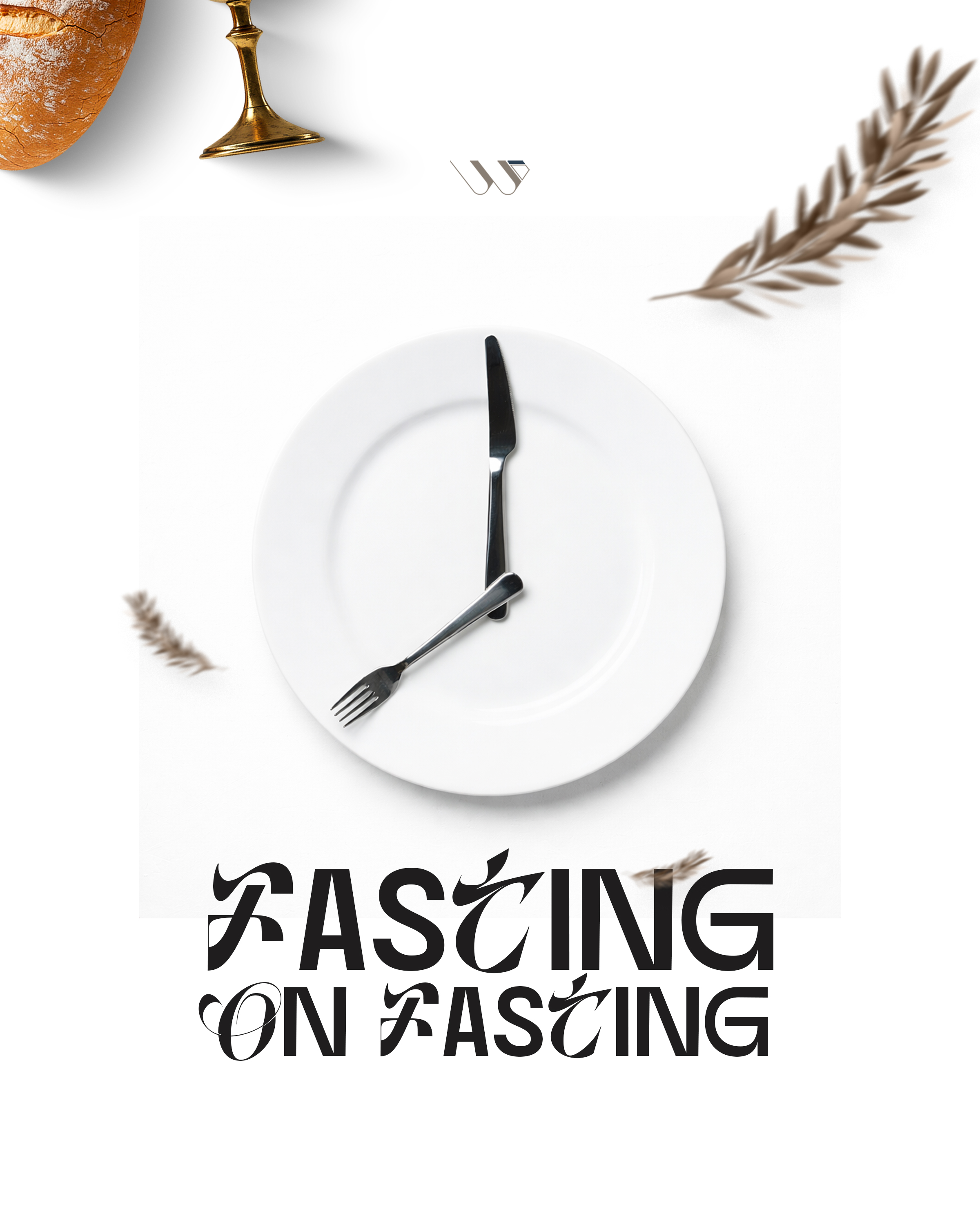
Fasting On Fasting
It’s always difficult to describe spiritual mysteries to a “woke" generation like ours. People ask questions such as, “Why would a loving Father deprive His children of answers to prayers simply because they had breakfast?” If, as it is said, “one doesn’t use food to punish a child,” why should God do so? Attempting to comprehend the knowledge of God through logical reasoning alone can be deeply misleading. “Unto you it is given to know the mystery of the kingdom of God” (Mark 4:11). Fasting is a spiritual mystery revealed through Scripture and affirmed by Jesus Himself: “The days will come, when the bridegroom shall be taken from them, and then shall they fast” (Matthew 9:14–15).
It would be hazardous to our faith to believe fasting is an archaic practice. Those who ask such questions often miss out on the rewards—yes, you read that right, rewards. Jesus Himself said, “Moreover, when you fast, do not be like the hypocrites, with a sad countenance… assuredly, I say to you, they have their reward… but when you fast, do not appear to men to be fasting, but to your Father who is in the secret place; and your Father who sees in secret will reward you openly” (Matthew 6:16–18). The aim of this piece is not to address misconceptions about fasting, but to disclose the rewards associated with it.
To begin properly with the orthodox definition of fasting: it is the voluntary abstinence from food, and sometimes drink, for the purpose of consecration. Jesus emphasised, “to your Father who is in the secret place; and your Father who sees in secret”—fasting is fundamentally about the secret place. In a heterodox sense, fasting may also be defined as self-denial and spiritual indulgence: depriving the flesh of its physical pleasures and replacing them with their spiritual equivalents. For example, physical food is replaced by feeding on the Word of God (Jeremiah 15:16), noisiness with quiet times in prayer.
Among the benefits of fasting is heightened spiritual sensitivity and discernment. Daniel, a man given to fasting—with results to show—said, “I set my face unto the Lord God, to seek by prayer and supplications, with fasting…” (Daniel 9:3). God has no difficulty speaking to His children, but the noise of our world today is overwhelming. Consider fasting as a spiritual noise-cancellation device; since God speaks with a “still small voice” (1 Kings 19:12), it takes quietness to hear Him.
Significantly, fasting in Scripture is often accompanied by burnt offerings and sacrifices. “Then all the children of Israel… fasted that day until even, and offered burnt offerings before the LORD” (Judges 20:26). While God no longer accepts animal sacrifices, He now receives our bodies—presented as “living sacrifices, holy and acceptable”—which is our spiritual worship (Romans 12:1). In this sense, fasting is a mode of worship rendered unto God (Isaiah 58:1–6).
One major reward of fasting that has been diluted over the years is spiritual renewal and power. Just as it is medically proven that fasting cleanses the body’s digestive and circulatory systems, spiritually, fasting renews the inner man (Isaiah 40:31). While fasting does not earn spiritual authority—authority comes through Christ (Luke 10:19)—it does empower believers for dominion over sin and the spiritual forces behind it. After Jesus fasted and was tempted in the wilderness, Scripture records that He returned “in the power of the Spirit” (Luke 4:1–14).
Ultimately, the value of fasting is not measured by its length, intensity, or visibility, but by its object. God confronts misplaced fasting with a sobering question: “When you fasted… did you at all fast unto Me, even to Me?” (Zechariah 7:5). This reveals that fasting is not a tool to pressure God, nor a religious badge to impress men, but an act of devotion unto Him. When fasting is reduced to mere self-discipline, ritual, or crisis-management, it loses its spiritual potency.



Comments
Please log in to comment.