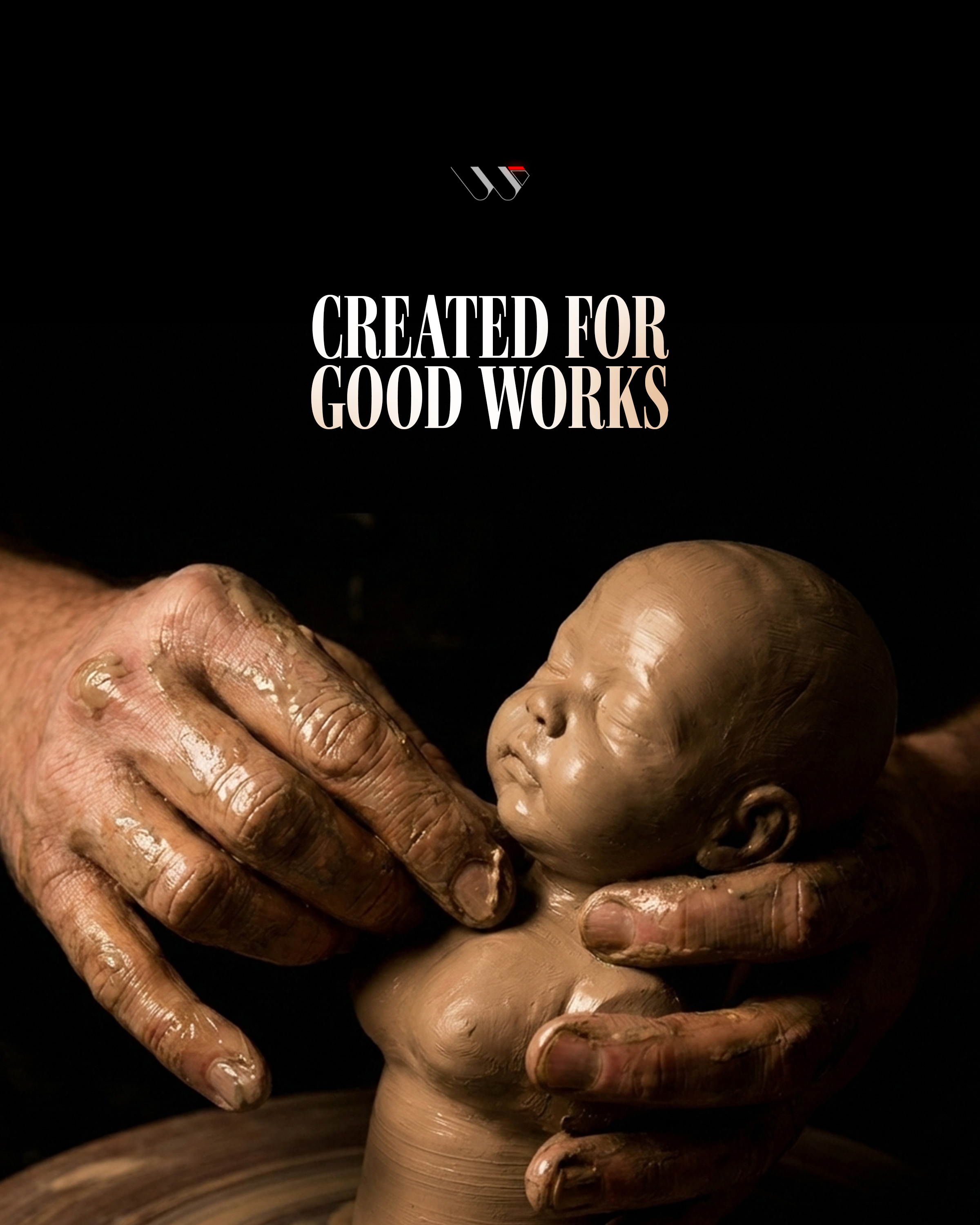
Created for Good Works
Our relationship with God shouldn’t end at salvation. God’s goal for the believer is not merely to save us or to atone for our sins, but to prepare us for good works. He did not redeem us by His blood to sit in church, gather knowledge, debate doctrine, and speak spiritual language. He saves us to use us. From the beginning, God’s intention has always been that our lives become instruments through which His government is expressed on the earth. We are not spectators in His kingdom; we are participants.
Scripture makes this clear: “For we are His workmanship, created in Christ Jesus unto good works, which God hath before ordained that we should walk in them” (Ephesians 2:10). Good works are not afterthoughts. They are part of the design—we were created for them.
This means every season, every lesson, every correction, and every process in our lives, from our birth till now—though may not be His plan or perfect will—are, in His providence, shaping us for usefulness. God is not simply building our comfort—He is building our capacity. He is preparing us so that when opportunity meets us, we are not found lacking.
The knowledge of God, His Word, and what is required of us are the vital positions we must take while navigating through seasons. Paul describes this preparation with powerful language: “All scripture is given by inspiration of God, and is profitable for doctrine, for reproof, for correction, for instruction in righteousness: that the man of God may be perfect, thoroughly furnished unto all good works” (2 Timothy 3:16–17).
“Thoroughly furnished”—I love the expression: like a house fully equipped, like a soldier fully trained (2 Timothy 2:3), like a vessel fully prepared for service (2 Timothy 2:21). God is not interested in ‘bread-and-butter’ believers. He desires men and women who are spiritually equipped, emotionally stable, rooted in study, grounded in the Word, and sensitive to His Spirit—people He can trust with responsibility.
Desire alone is never enough. Willingness alone is not enough. Preparation is necessary. A friend and big brother always say, “God is not looking for availability alone; He’s also looking for usability.” Throughout Scripture, we see a consistent pattern: those whom God used greatly were first prepared deeply.
Joseph accessed vision early, but he suffered betrayal, slavery, and prison before arriving at the palace (Psalm 105:16–22). Those hidden years were not delays; they were training days. David was anointed king as a boy, yet returned to the wilderness, where he learned leadership and faithfulness in lonely fields as a shepherd boy (1 Samuel 16:11–13). There, in obscurity, courage and intimacy with God were formed. Leadership requires capacity. Even Jesus, though the Son of God, spent thirty quiet years before three years of ministry (Luke 2:52). Before public impact, there is always private formation.
God works in us before He works through us. Preparation often looks ordinary. Sometimes it feels slow. At times, it even feels hidden. But heaven wastes nothing. Every act of obedience, every quiet discipline, every moment of integrity is fortifying our foundation.
In these unseen places, character is built. And character is what sustains calling. Gifts may attract attention, but character sustains usefulness. Power without preparation can destroy a person, but preparation makes power safe. That is why the Spirit first works on who we are before what we do. He shapes our hearts, corrects our motives, and teaches us faithfulness in small things. Jesus said, “He that is faithful in that which is least is faithful also in much” (Luke 16:10). The little things are training grounds for the greater things.
Even the fruit of the Spirit—love, joy, peace, longsuffering, gentleness, goodness, faith, meekness, temperance (Galatians 5:22–23)—is part of this preparation. These qualities are not optional virtues; they are evidence that we are becoming fit for God’s work. They steady us so we do not crumble under pressure or misuse what God places in our hands.
A prepared believer is not easily distracted or discouraged. They are dependable, which makes them usable. Apostle Paul wrote, “If a man therefore purge himself… he shall be a vessel unto honour, sanctified, and meet for the master’s use, and prepared unto every good work” (2 Timothy 2:21). The goal is to be a vessel the Master can pick up at any time without hesitation—ready to serve, obey, and represent Him well.
Because when preparation is complete, good works are no longer forced; they flow naturally from the depths of our spirit. Service stops feeling like a burden and becomes an expression of who we have become in Christ. That is growing to the measure of the stature of the fullness of Christ (Ephesians 4:13), which is the measure of our faith.
Continued…



Comments
Please log in to comment.