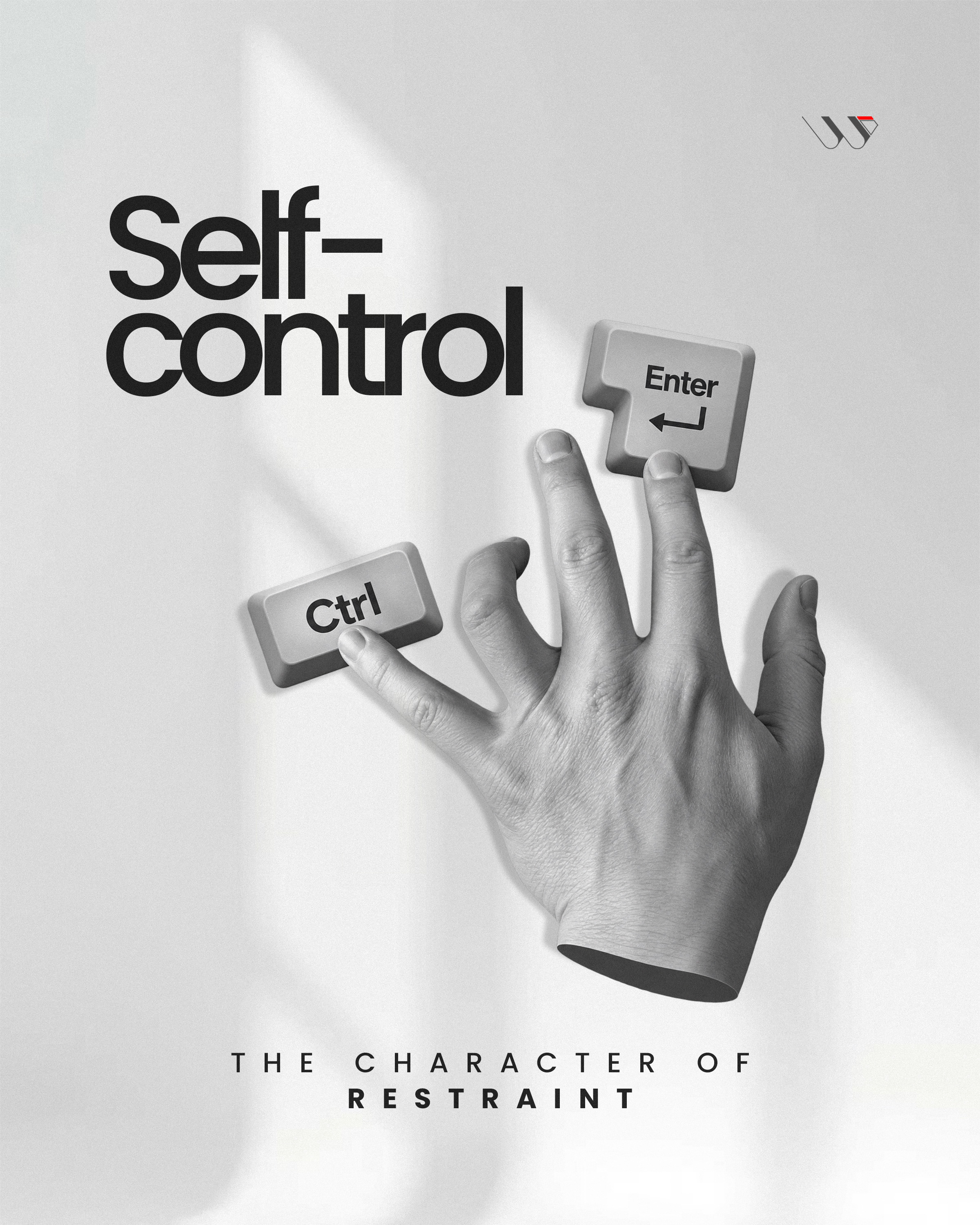
Self-Control: The Character of Restraint
There is a difference between having a desire and being ruled by it. We may feel angry and still choose not to speak destructively. We may strongly want something and still decide that having it would be foolish. We may feel offended and resist the urge to retaliate. We may be tired, tempted, excited, or emotionally overwhelmed and still refuse to let that moment determine our conduct. This is where self-control becomes one of the clearest expressions of spiritual maturity.
Paul lists “temperance” or self-control among the fruit of the Spirit (Galatians 5:22–23). That alone shows that self-control is not merely the mark of strong-willed people. It is part of the character the Holy Spirit desires to produce in every believer. The Christian life is not one in which every impulse directs us simply because it feels strong. As the Spirit works within us, we increasingly develop the ability to bring our appetites, emotions and reactions under proper government.
Self-Control Is Inner Government
Proverbs gives one of the strongest pictures of a person without self-control: “He that hath no rule over his own spirit is like a city that is broken down, and without walls” (Proverbs 25:28). In Bible times, a city without walls was exposed to threats. It had little protection from invasion, and just anything could go in and out.
Similarly, a person without self-control becomes vulnerable to whatever impulse, emotion, appetite, or pressure demands immediate expression. If anger can immediately control our mouth, appetite control our choices, lust control our eyes, offence control our reactions, or excitement control our judgement, then whatever impulse is strongest in the moment is continually deciding what we do. Self-control restores government.
Paul writes, “All things are lawful unto me, but I will not be brought under the power of any” (1 Corinthians 6:12). That is a powerful definition of freedom. True freedom is not merely having permission to do something; it is possessing enough command over yourself not to become enslaved by what you are free to enjoy. The question is not only, “Can I do this?” but also, “Is this beginning to control me?”
Something need not be sinful in itself for our relationship with it to become unhealthy. Food can be good and still become excessive. Rest is necessary, but it can become laziness. Entertainment can be harmless and yet begin to consume time that belongs elsewhere. Money is useful, but it can become greed. Even work can become an appetite that consumes relationships and health. Self-control asks whether anything in our lives has gradually acquired more authority over us than it should.
Jesus and Self-Control
Jesus gives us a remarkable picture of self-control because He was never ruled by appetite, pressure or provocation. After fasting forty days, He was hungry, and Satan tempted Him to turn stones into bread. Hunger was legitimate; allowing Satan to dictate how that hunger should be satisfied was not. Jesus refused to allow a legitimate appetite to become an independent authority over His obedience and submission to God. He answered, “Man shall not live by bread alone, but by every word that proceedeth out of the mouth of God” (Matthew 4:4).
Later, when Jesus was arrested, Peter attempted to defend Him with a sword. Jesus told him to put it away and said He could ask the Father for “more than twelve legions of angels” (Matthew 26:53). He had the power but did not use it just because it was available.
That is self-control: the ability to possess power or liberty without always needing to exercise it, to experience desire without automatically satisfying it, and to feel emotion without surrendering judgment to it.
Self-Control in Our Emotions
Self-control does not mean we stop feeling. Scripture never teaches emotional numbness. Jesus felt compassion, sorrow and anger. The difference is that emotion did not become the final authority over His actions.
Paul says, “Be ye angry, and sin not” (Ephesians 4:26). Anger can arise, but anger does not have to become insult, retaliation or violence. Fear may be present without becoming disobedience. Disappointment can be real without becoming bitterness.
Proverbs says, “He that is slow to anger is better than the mighty; and he that ruleth his spirit than he that taketh a city” (Proverbs 16:32). Scripture regards self-governance as a greater victory than conquering something outside oneself.
Self-Control in Speech
The mouth is one of the clearest places where self-control shows itself. James writes, “If any man offend not in word, the same is a perfect man, and able also to bridle the whole body” (James 3:2). He compares the tongue to a small fire capable of producing enormous damage. Many things we later regret were not carefully planned; they escaped in a moment when emotion outweighed restraint. Self-control creates a gap between feeling and speaking.
James says, “Let every man be swift to hear, slow to speak, slow to wrath” (James 1:19). Sometimes maturity is simply the ability to wait before responding. The message does not have to be sent immediately. The argument does not have to be won tonight. The sharp thought does not need to become a spoken word. Proverbs says, “Whoso keepeth his mouth and his tongue keepeth his soul from troubles” (Proverbs 21:23). We avoid troubles simply by learning when not to speak.
Self-Control and Appetite
Paul understood that spiritual discipline must also reach the body. He writes, “I keep under my body, and bring it into subjection” (1 Corinthians 9:27). The language is deliberate. Paul did not assume that every physical desire should automatically be obeyed. Our appetites are good servants but poor masters.
This applies to food, sex, sleep, spending, entertainment and every other legitimate desire that can become excessive when left without boundaries. Paul says, “Walk in the Spirit, and ye shall not fulfil the lust of the flesh” (Galatians 5:16). The Christian answer to uncontrolled appetite is not simply stronger human determination; it is learning to live under the influence of the Holy Spirit while deliberately making choices that agree with truth.
Self-Control in Relationships
Self-control is also deeply relational. Relationships are often damaged not because people don't love one another, but because they don't control what they do when disappointed, angry, or afraid.
A spouse says something hurtful and the immediate instinct is to say something worse. A friend disappoints us, and we withdraw affection to punish them. Someone embarrasses us, and we expose something about them in return. Self-control interrupts this cycle.
Paul says, “Recompense to no man evil for evil” (Romans 12:17). That requires more than knowing retaliation is wrong; it requires the inward ability to refuse the impulse when retaliation feels justified. This is why self-control supports many of the virtues we have already considered. Forgiveness requires control over the desire for revenge. Gentleness requires restraint over strength. Patience requires control over irritation. Consideration requires us to restrain our preferences. Peacemaking often requires us to control the urge to have the final word. Without self-control, many other Christian virtues become difficult to sustain.
Self-Control Is Not Suppression
It is important to distinguish between self-control and suppression: suppression says, “I must pretend I do not feel this.” Self-control says, “I recognise what I feel, but I will decide what to do with it.” For our purposes, suppression means pretending the feeling is not there; self-control acknowledges the feeling while refusing to make it the final authority.
Jesus in Gethsemane did not deny His anguish. He said, “My soul is exceeding sorrowful, even unto death” (Matthew 26:38), yet He still prayed, “Nevertheless not my will, but thine, be done” (Luke 22:42). That is not suppression; it is honest emotion brought into submission to God’s will.
Self-Control Must Be Practised
Self-control is not formed overnight, especially after a long pattern of gratifying the flesh. It is a fruit produced by the Spirit, yet Scripture calls believers to deliberate cultivation through discipline, repeated obedience, and the continual yielding of our desires to God.
Peter writes, “Giving all diligence, add to your faith virtue; and to virtue knowledge; and to knowledge temperance” (2 Peter 1:5–6). The Spirit produces the fruit, but the believer cooperates through choices, habits and obedience.
This is why small disciplines matter—learning to stop when you have had enough matters. Keeping to a commitment when comfort suggests otherwise matters. Delaying gratification matters. Refusing to answer immediately when angry matters. Turning away from what feeds temptation matters. Repeated choices eventually form character.
Paul compared the Christian life to that of an athlete who is “temperate in all things” because he pursues a prize (1 Corinthians 9:25). Athletes don't accept discipline merely because it feels restrictive; they embrace it because they understand what it prepares them to achieve. Self-control works the same way. It doesn't destroy freedom; it protects it. Paul uses an athlete's discipline to describe deliberate self-government. His point extends beyond food or bodily appetite: he refuses to live carelessly while pursuing the calling placed before him.
Ultimately, self-control is learning that not every desire must be satisfied, not every feeling must be acted upon, and not every impulse deserves obedience. With the help of the Holy Spirit, it is the ability to choose what is right even when something within us strongly wants otherwise. A person ruled by appetite may appear free, but Scripture presents true freedom differently: “I will not be brought under the power of any” (1 Corinthians 6:12).
As Christ is formed in us, may our desires become servants rather than masters, our emotions advisers rather than rulers, and our choices increasingly governed by truth and the Spirit of God.



Comments
Please log in to comment.