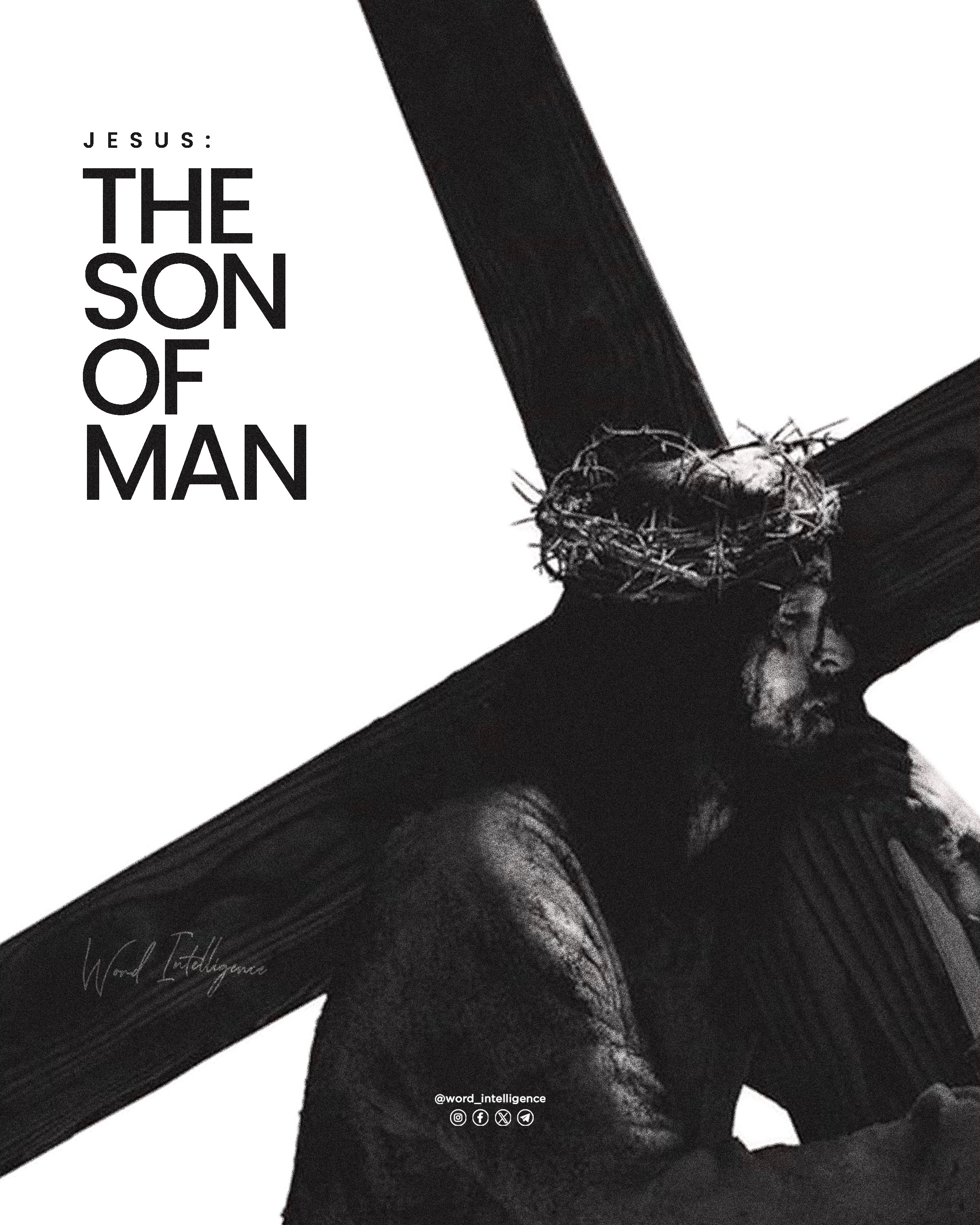
Jesus, the Son of Man
For a very long time, I understood the title “Son of Man” merely as Jesus’ humble way of referring to Himself while affirming His identity as the Son of God. Yet, to be candid, I must admit that even now, I wouldn’t say I have fully grasped from Scripture the profound mystery of Jesus as God incarnate—God taking upon Himself human flesh and dwelling among men. It’s a mystery!
In previous doses, we explored why and how Jesus, being God, is also called the Son of God. To reiterate, “He is not called the Son of God by reason of birth but nomenclature, according to character and assignment, the Messenger and express embodiment of the Word—sent forth to declare, demonstrate, and deliver the will of the Father”.
Returning to the title “Son of Man,” the earliest reference appears in Daniel’s vision. In Daniel 7:13–14, the prophet records:
“I saw in the night visions, and behold, one like the Son of man came with the clouds of heaven, and came to the Ancient of days, and they brought him near before him. And there was given him dominion, and glory, and a kingdom, that all people, nations, and languages, should serve him: his dominion is an everlasting dominion, which shall not pass away, and his kingdom that which shall not be destroyed.”
While I was still at university, specifically during my first year, I spent the first few months living in the same apartment as my landlady, who has since become a mother to me. Every evening, she would tune her radio to a particular preacher whose messages filled the house. One evening, if I recall correctly, it was only my second day there—I heard, for the very first time, that Jesus is the last Adam. The preacher quoted 1 Corinthians 15:45: “The first man Adam was made a living soul; the last Adam was made a quickening spirit”.
If we look back to Genesis 1:26–27, we find a vivid picture of humanity’s original dominion: “And God said, Let us make man in our image, after our likeness: and let them have dominion over the fish of the sea, and over the fowl of the air, and over the cattle, and over all the earth, and over every creeping thing that creepeth upon the earth. So God created man in his own image”. In this moment, man automatically became a stakeholder in God’s Kingdom because God entrusted him with a throne of authority.
However, fast forward to Genesis chapter 3: Adam, the first man, traded this sceptre and forfeited his throne to sin. Yet the throne itself was designed exclusively for a living soul (a spirited soul in a body); therefore, Satan could not occupy it. The throne remained vacant, and the only being entitled to sit upon it is the sons of man (Psalm 115:16).
Still, this alone would not have been sufficient reason for God to descend to the level of humanity. He could have raised Abraham or Moses, and prepared them to reclaim the throne. But the sceptre—the symbol of authority had been taken and was in Satan’s possession. At the time, no man possessed the holiness required to conquer death and hell. Therefore, God Himself became man.
After His ascension, having disarmed principalities and powers and made a public spectacle of them, Jesus proclaimed: “I am he that liveth, and was dead; and, behold, I am alive for evermore, Amen; and have the keys of hell and of death” (Revelation 1:18). He now holds the legal and eternal right to occupy the throne. And He has also given thrones and kingdoms to the sons of men (Daniel 7:27). Hallelujah!
This is why grace is so important. What does this mean for you and me? One man won it all, and by His name, we now have access to dominion. This reality does not in any way diminish His divinity. As Paul wrote to Timothy: “For there is one God, and one mediator between God and men, the man Christ Jesus” (1 Timothy 2:5). Therefore, when we pray, we pray to the Father through Jesus—our representative in the highest court of Heaven, as affirmed in John 16:23.
Continued…




Comments
Please log in to comment.