Abide in the True Vine
Back in secondary school, we were assigned a science project to plant a maize seed. I remember how much I loved and cared for that tiny plant. Every morning, I would check on it, carefully remove weeds around it, water it adequately, and even go as far as brushing off specks of dirt from its leaves—things that, in hindsight, seemed insignificant but mattered to me deeply.
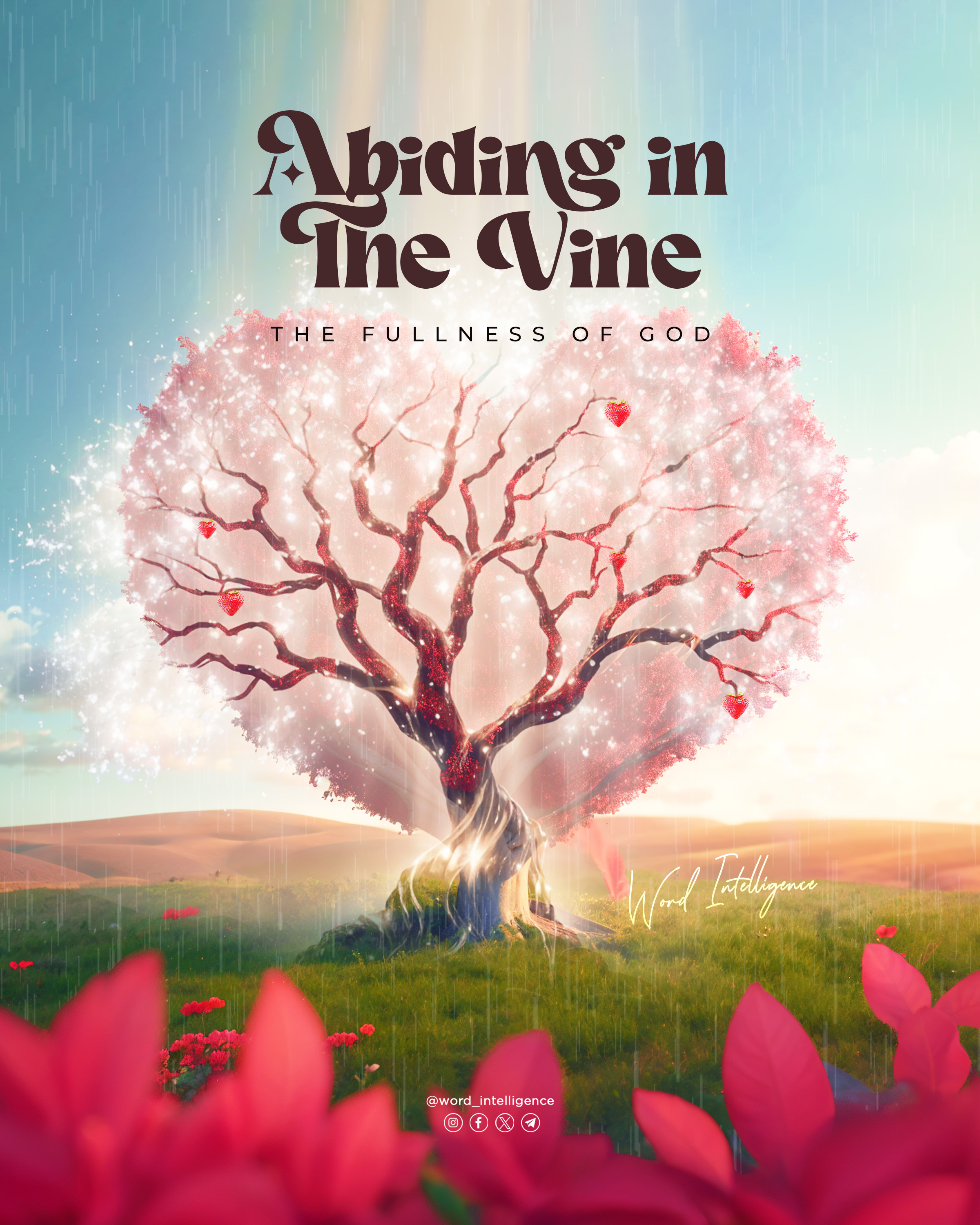
This simple act illustrates just how much the husbandman (The Father) loves His planting. Jesus is the Vine, and we are the branches; therefore, as a part of the Vine, we are partakers of that same divine love. Jesus prayed, “I in them, and thou in me, that they may be made perfect in one; and that the world may know that thou hast sent me, and hast loved them, as thou hast loved me” (John 17:23).
At its core, the illustration of the True Vine in John 15 is not primarily about the cutting off of fruitless branches; rather, I believe it is first and foremost a revelation of God’s unwavering love to those who are in Christ.
“I am the true vine, and my Father is the husbandman. Every branch in me that bears not fruit he takes away: and every branch that bears fruit, he prunes it*, that it may bring forth more fruit”.
“Now ye are clean through the word which I have spoken unto you. Abide in me, and I in
you. As the branch cannot bear fruit of itself, except it abide in the vine; no more can ye, except ye abide in me.”
“I am the vine, ye are the branches: He that abides in me, and I in him, the same brings forth much fruit: for without me ye can do nothing. If a man abides not in me, he is cast forth as a branch, and is withered; and men gather them, and cast them into the fire, and they are burned” (John 15:1-6).
At first glance, these words may seem paradoxical: “He cuts off every branch that bears no fruit, while every branch that bears fruit he prunes”. In both cases, there’s a form of cutting involved. But on closer reflection, it becomes clear that Jesus is not speaking of a dual judgment. He said, “Now ye are clean through the word which I have spoken
unto you". The pruning is more of a natural process in which old branches give way for new ones to sprout.
He is distinguishing between separation and sanctification. Jesus clarifies—“If a man abides not in me, he is cast forth as a branch”, revealing that separation from the Vine is not God’s desire; it is self-inflicted. The real issue is not fruitfulness in and of itself, but ‘not
abiding’, as whoever is connected to the Vine is sustained and empowered to bear fruit.
Therefore, what the husbandman cuts off are not the branches themselves, but the traits/fruits on the branch inconsistent with the life of Christ (the Vine). While a branch hangs on a stem, the sap flows through the entire tree. This is the reflection of Jesus' words, “Abide in me, and I in you”. The sap symbolises Living Waters—the person of the Holy Spirit, who flows through every believer, enabling us to bear the fruit of the Spirit,
which is love (Galatians 5:22).
Here we see the mutual indwelling and interpenetration of the three Persons of the Trinity (perichoresis) flowing through and within us. Love is the expression of the fullness of God; “God is love; and he that dwelleth in love dwelleth in God, and God in him" (1 John
4:16).
Verse 9 of John 15 says, “As the Father hath loved me, so have I loved you: continue ye in my love” (John 15:9). This love is not self-generated; it originates from the Father, manifested through the Son, flows by the Spirit into the believer and is the primary evidence that we are alive in Him.




Comments
Please log in to comment.