The Spirit: Not a Doctrine, but a Person
The Holy Spirit is not a church doctrine we merely believe in or preach. I emphasise this because of something that happened last Sunday. On my way home from church with my brother and a friend, a young gentleman like me approached us to share the gospel. Even though I felt we were probably not his target audience, I still chose to listen. I didn’t want to discourage someone who was sincerely trying to do God’s work. So, I gave him my full attention. He began with debatable topics, trying to question and dissect my faith. I listened patiently as he attempted to “properly” introduce Jesus to me. But then he made a statement that immediately caught my spirit. He referred to it as “the doctrine of the Bible.”
Right there, I discerned he was one of those heavy on theology but light on revelation — full of arguments, yet empty of life. It’s what Scripture describes as: “They have a zeal for God, but not according to knowledge” (Romans 10:2). He knew concepts, but he did not seem to really know the Person.
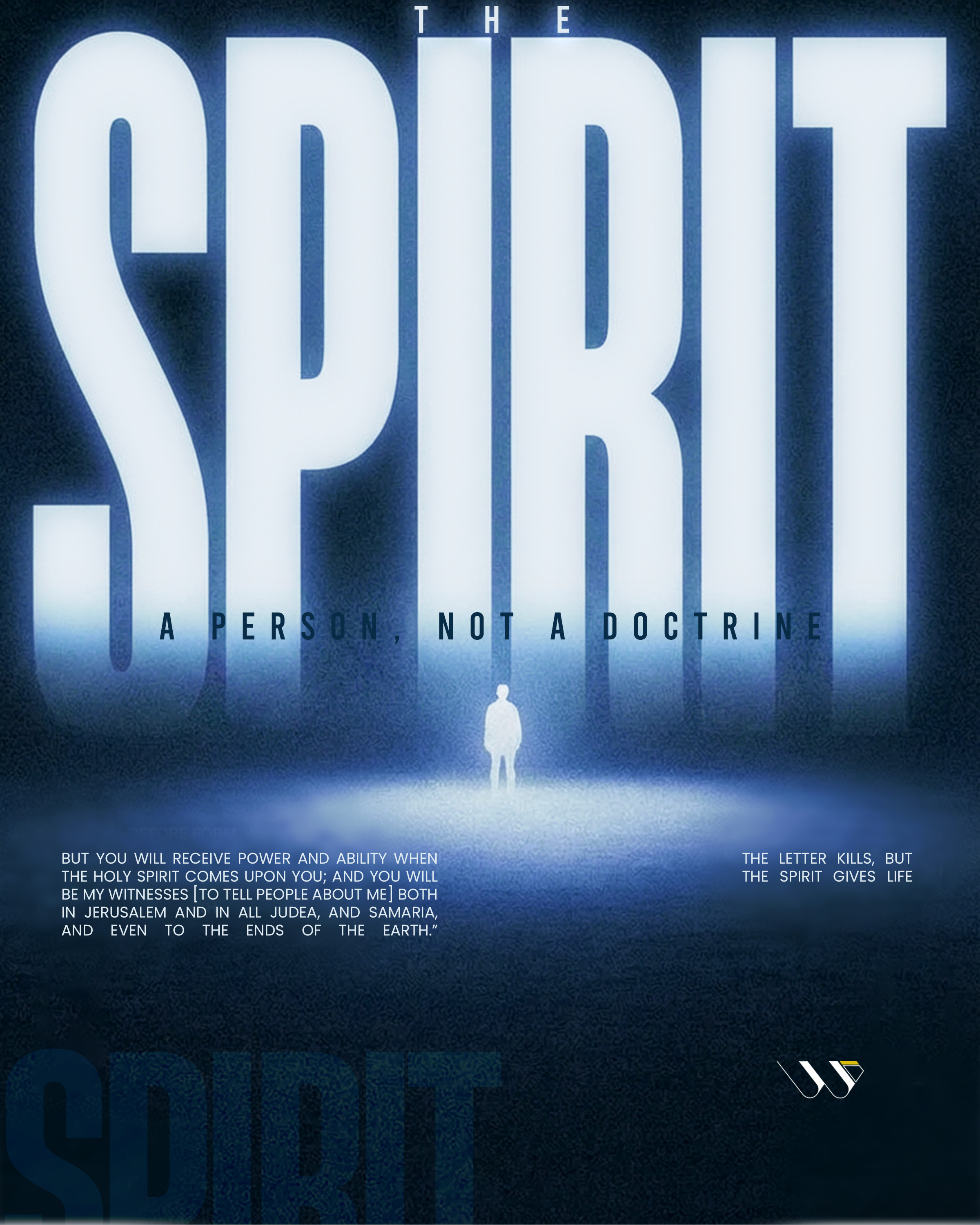
It may sound unnecessary to recount this event, but it explains why I insist that the Holy Spirit is not a doctrine. Doctrine has its place. Apostle Paul spoke of different forms of doctrine — sound doctrine (Titus 2:1), disputable doctrine (Romans 14:1), unsound doctrine (1 Timothy 1:9–10), and even false doctrine or heresy (1 Timothy 4:1). Doctrine helps teach principles, lay structure, and guide belief: “All scripture is given by inspiration of God, and is profitable… for doctrine” (2 Timothy 3:16). Doctrines come from Scripture, but the Spirit (God Himself) is greater than doctrine. “The letter kills, but the Spirit gives life” (2 Corinthians 3:6). “It is the Spirit who gives life; the flesh profits nothing. The words that I speak to you are spirit, and they are life” (John 6:63).
The Word of God reveals God, but not every isolated verse, taken alone, fully captures who God is. On the surface, the Bible can be mishandled like a constitution, a debating tool — almost like a Rorschach test, where people project their own opinions onto the text and use verses to support whatever claim they want to make. That is why some people misquote Scriptures to manipulate or control others. But beneath doctrine are foundational, unshakable truths about God’s nature (Hebrews 1:1–2). These truths are not arguments to win; they are realities to receive.
For instance, Jesus is Lord. That is not a doctrine open for negotiation — it is a revelation and a conclusion. God created the heavens and the earth. That is not a theological theory — it is truth. Yet today, people still debate things like the prosperity gospel or other teachings because those belong to doctrinal interpretations. Doctrines are derivatives — explanations and frameworks built around truth. They teach principles, they guide understanding. But they are not the Spirit behind Scriptures.
The Holy Spirit is not a concept to analyse or a topic to debate. He is not a theological perspective; He is God — present, active, and tangible. Jesus did not say, “I will send you a doctrine.” He said, “I will pray the Father, and He shall give you another Comforter… even the Spirit of truth… He dwells with you and shall be in you” (John 14:16–17). Doctrine can inform you, but only the Spirit can indwell you.
You can study doctrine and still be spiritually dry. You can memorise theology and still lack its power. But when the Holy Spirit is truly at work in a person, something changes that no book knowledge can produce. He reveals the wisdom and power of God, “you shall receive power when the Holy Spirit has come upon you” (Acts 1:8). Doctrine without the Spirit will produce a dead religion, but the life in His Spirit is what transforms us.
This is why the early church did not merely defend ideas — they demonstrated power. They did not say, “We believe in the Holy Spirit” as a statement of faith only; they experienced and manifested Him daily. He spoke to them (Acts 13:2), directed their steps (Acts 16:6–7), filled them with boldness (Acts 4:31), and confirmed the Word with power (Hebrews 2:4). The Spirit was not a subject to lay doctrine; He was the life behind their ministry and the life they lived for all to see (Romans 8:19).
Even today, nothing has changed. The Holy Spirit is not meant to be discussed from a distance but known personally. We learn of Him not simply to bring us to His knowledge but His power. He is not information for the mind; He is fellowship for the heart. Because Christianity is not built on doctrines alone, it is built on a relationship with the living God. And that relationship is made real through the Holy Spirit. Continued...






Comments
Please log in to comment.